Whispers of the Crescent: The Forgotten Ottoman Hammam of Nessebar
People tour Nessebar by church. They come for the domes, the ceramic rosettes and the frescoes, and in the northern part of the peninsula, not far from St John Aliturgetos, they walk past a low run of stone masonry with grass in it. These are the remains of the old Turkish bath, the town's public hammam from the Ottoman period.
The building is usually dated to the late 16th or early 17th century, and only foundations and partial walls survive: no dome, no marble, no roof. Even so, it is one of the few structures here that speaks not about faith and power but about ordinary life. For the wider period, see the Ottoman period and five centuries of change.
How an Ottoman bath worked
A hammam is not a Turkish sauna in the modern sense. It is a piece of engineering with a fixed sequence of rooms that the body passes through, from cool to hot and back again.
| Room | What happens there |
|---|---|
| Undressing room | Undress, leave clothes, and sit here afterwards for tea |
| Cold room | A transition space, and where you cool down on the way out |
| Warm room | Gradual heating, washing, scrubbing |
| Hot room | Steam, the central stone, massage and the real bathing |
The hot room holds the feature that makes a hammam recognisable: the navel stone, a large marble slab in the middle, heated from below, where bathers lie on their backs and are scrubbed and massaged.
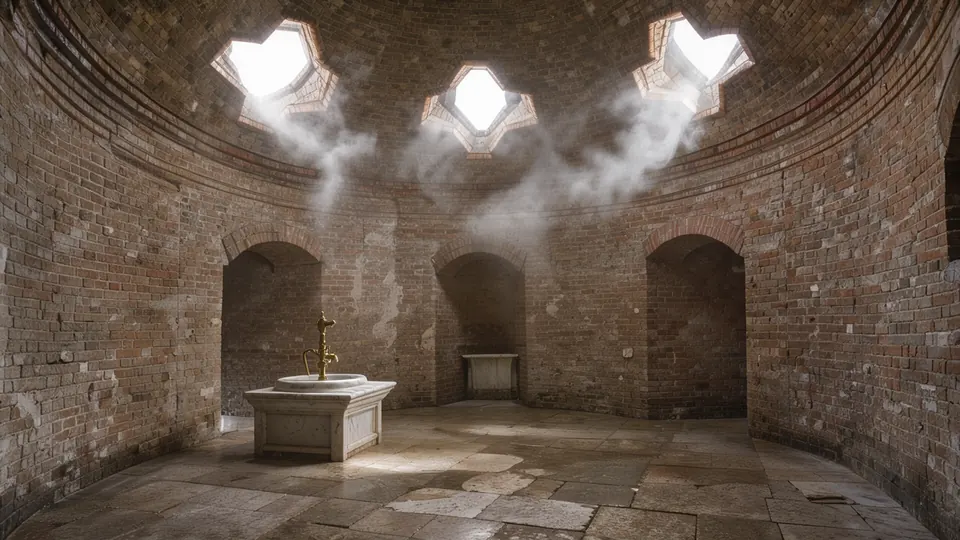
The heating is under the floor: the furnace sits outside the bathing rooms, and hot air and smoke travel through channels in the floor and walls before leaving by a chimney, on the Roman hypocaust principle. Above, as a rule, sits a dome pierced by small round openings closed with thick glass caps, known as elephant eyes. By day they drop shafts of light that the steam makes visible. In Nessebar that is the part you have to imagine, because it is gone.
Why the bath was an institution
In a town with no plumbing in the houses, a public bath is a necessity, but its social role was larger than its hygienic one, especially for women. Hammams ran in shifts: some hours for men, others for women. The women's day was an event, with food, children and hours to spare. There:
- news was exchanged, in a world without newspapers;
- girls were looked over and marriages arranged;
- ritual bathing before a wedding took place, with music and singing;
- women came after childbirth, following custom;
- friendships were kept up where women rarely went out alone.
The church was for prayer, the market for trade, the hammam for life.
The water question
On a small rocky peninsula fresh water is the hardest resource of all, and a bath consumes a great deal of it. How Nessebar solved this is a question for specialists; as a rule, coastal towns relied on wells, rainwater cisterns and supply brought in from outside. Keep that in mind and the narrow isthmus stops being merely a road.
Nessebar under the crescent, 1453 to 1878
Ottoman rule over Mesembria began in 1453 and lasted until 1878, four and a half centuries, longer than most visitors realise. The town then was neither purely Christian nor purely Muslim: a mixed port of Greeks, Bulgarians and Turks, living on fishing, vineyards and trade. Many of the timber houses Nessebar is famous for date from the end of this period: see the Revival period houses.
Important: this is not the early Byzantine bath
Here lies the most common confusion in Nessebar. The peninsula has two different bath complexes from two different eras:
- The early Byzantine baths (thermae), from the 6th century, contemporaries of the Old Metropolitan Church. A late Roman style public bath, a thousand years older.
- The Ottoman hammam, late 16th or early 17th century, in the northern part of the peninsula, not far from St John Aliturgetos.
They get mixed up constantly online, but they are not the same building and not the same civilisation. The interactive map of Nessebar is the quickest way to check what sits where.
What you will actually see
Honestly, this is not a spectacular site. You see foundations, wall outlines and in places a higher run of masonry, enough to trace the plan if you know what to look for and nothing at all if you do not. It is unlit and modestly signed at best, which makes it a good second-visit target: first the churches, then the layers between them.
Practical information
- Ticket: none, it is a free open-air ruin. You pay only for the roofed museum objects: the Archaeological Museum and St Stephen at 4.60 € for adults and 2.30 € for children, the smaller churches at 2.56 €, the Ethnographic Museum at 3.07 €.
- Where: the northern part of the peninsula, not far from St John Aliturgetos. Combine the two in one walk.
- Time needed: ten minutes for a look, about twenty if you try to read the plan.
- When: daytime, since there is no lighting after dark.
- Pair it with the Ethnographic Museum, which puts real objects to the same domestic life.
- Getting there: on foot from anywhere in the Old Town; bus line 1 from Sunny Beach runs every 10–15 minutes in summer, ticket about 1 €.
Frequently asked questions
Can I go inside the hammam?
There is nothing to go inside: no roof and no surviving interior rooms, only foundations and sections of wall, so you view it from outside by walking around the site.
Did this bath operate until recently?
No. It went out of use long ago and is an archaeological site today. There is no working historic hammam in Nessebar that you can bathe in.
Is it worth finding if I only have one day?
With one day, prioritise the churches, the fortress walls and the Archaeological Museum. The hammam is a second-day stop for travellers who want the Ottoman layer of the town.
Get local stories & deals
One email a month with the best Black Sea stories and seasonal deals. No spam.