The Heart of Ancient Mesembria: The Old Metropolitan Church (St. Sophia)
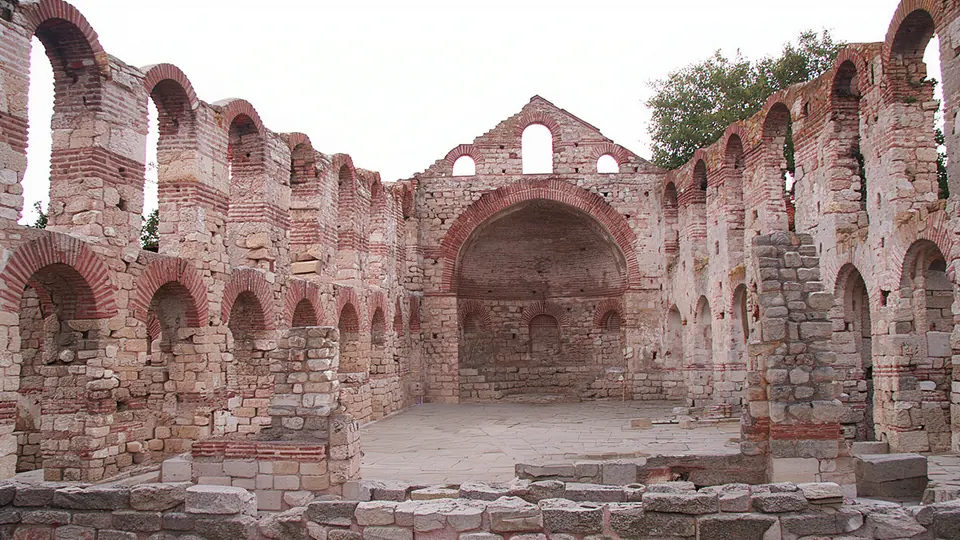
In the middle of Old Nessebar's central square, hemmed in by souvenir stalls and cafe tables, stands a large roofless shell of stone. Rows of arches frame the sky, gulls cut through them, and somewhere below a tourist is haggling over a fridge magnet. This is the Old Metropolitan Church, also known as St. Sophia, cathedral of the bishops of Mesembria and the largest early Christian building the peninsula has kept.
It was built in the late 5th or early 6th century, when Mesembria was a wealthy Byzantine port rather than a resort, and it measures about 25.5 metres in length. There is no ticket office and no fence, so most visitors pass it several times a day and stop noticing it. That is why it deserves a deliberate half hour. For the wider walk, see our complete guide to Nessebar Old Town.
What an early Christian basilica actually is
The word basilica comes not from a temple but from the Roman public hall, a long covered room used for trade and law. Early Christianity copied that practical hall rather than the ancient temple, because a hall holds people. St. Sophia follows the scheme exactly, west to east:
- Atrium — an open courtyard where the congregation gathered and usually washed hands and face.
- Narthex — a transverse vestibule across the full width of the building, the place for the unbaptised and the penitents.
- Nave and two aisles — the central nave wider and taller, separated from the aisles by rows of massive stone pillars and brick arches.
- Apse — the semicircular niche at the east, facing sunrise, holding the synthronon, the stepped clergy seating with the bishop's throne in the middle.
The layout is not decoration; it is an instruction for movement and hierarchy. Learn it once and you can read any ruin of this type along the coast.
The seat of a bishop
A metropolitan see means the town is the administrative centre of a church district: the bishop sits here, priests for the surrounding villages are ordained here, and relics are kept here. Mesembria lived off trade, and the largest building on the square told anyone stepping off a boat what rank this town held. See also the Roman and Byzantine periods.
Opus mixtum
The walls are built in opus mixtum, courses of dressed stone alternating with bands of brick in thick mortar joints. The brick bands level the masonry after every few uneven stone courses and give the builders a true horizontal to work from. The same handwriting appears in the fortification walls of Nessebar, from the same era and the same building school.
| Period | What happened |
|---|---|
| Late 5th – early 6th c. | The three-aisled basilica with narthex and atrium is built |
| 6th–7th c. | First major rebuilding |
| Around the 9th c. | Rebuilt and enlarged, now inside the First Bulgarian Empire |
| 1257 | A Venetian raid; relics are carried off to Venice |
| After 1453 | The church falls out of use and slowly collapses |
| Today | A free open-air ruin, with occasional summer concerts |
Basilica versus cross-domed church
Within a few hundred metres Nessebar shows two different ways of building a church. St. Sophia is the early type: wide, longitudinal, low and timber-roofed, made for a large congregation, and the movement through it is horizontal. The small late-medieval churches around it, such as St. John Aliturgetos, are cross-domed: a square core, four columns, a dome, and the movement is vertical. The change of plan reflects a change in who paid: a bishop's city on one side, a parish or wealthy family on the other.
How to read the ruin
- The west threshold — the atrium stood here; the building started earlier than it looks.
- The narthex — the first transverse space, marked by the cross wall separating it from the nave.
- The pillars and arches — stand in the central nave and look up. Where the sky is now, there was a timber roof.
- The apse — step into the semicircular niche and you stand where the synthronon was.
- The masonry — stone, brick, mortar and patches of later repair in different material.
The interactive map of Nessebar shows where this sits.
Practical information
- Ticket: none. St. Sophia is an open-air ruin, free at any hour. You pay only for the roofed museum objects.
- If you continue to the museums: the Archaeological Museum and the Church of St Stephen are 4.60 € for adults and 2.30 € for children; the smaller churches 2.56 €; the Ethnographic Museum 3.07 €. Combined tickets run roughly 6.14 € to 17.90 € for an adult, and summer hours are generally longer.
- Time needed: 20 to 30 minutes if you read the ruin properly.
- When to go: in July and August the square is loud from late morning to early evening, with stalls right against the walls. Early morning or dusk is a different building.
- Getting there: on foot from anywhere in the Old Town. Bus line 1 from Sunny Beach runs roughly every 10–15 minutes in summer, ticket about 1 €.
- Pair it with the Archaeological Museum, a few minutes away.
Frequently asked questions
Do I need a ticket or a reservation?
No. St. Sophia is a free open-air ruin in the middle of town, with no gate and no booking. Tickets apply only to the roofed museum sites, among them the Archaeological Museum, St Stephen and the Ethnographic Museum.
What is the difference between the Old and the New Metropolitan Church?
St. Sophia is the Old Metropolis, the early Christian basilica on the central square. The New Metropolis is the Church of St Stephen, which took over as the main town church later and is today a roofed museum with surviving frescoes and an entrance fee.
Can I walk inside the ruin?
Yes, along the route marked on site, but the walls are old and partly consolidated, so do not climb or sit on the masonry. The ground is uneven, so keep small children close around the pillars and steps.
Get local stories & deals
One email a month with the best Black Sea stories and seasonal deals. No spam.