Conquest and a New Order
The Ottoman Turks conquered Nessebar in 1453, beginning a period of rule that would last until 1878. This era brought profound changes to the city's character, though many of its Christian monuments survived remarkably well.
The year 1453 was momentous across the whole Byzantine world: it was the year Constantinople itself fell to Sultan Mehmed II, bringing the thousand-year Eastern Roman Empire to an end. Mesembria, long a Byzantine port, passed into Ottoman hands in the same period, ending its role as a frontier stronghold and absorbing it into a vast empire that stretched across three continents. The 425 years of Ottoman rule that followed are remembered in Bulgaria as the centuries of "Ottoman yoke," yet for Nessebar they were also a long period of relative stability and continued maritime trade.
Christians, Churches, and Coexistence
Under Ottoman rule, several churches were converted into mosques, while others fell into disrepair. However, the Ottomans generally tolerated the Christian population of Nessebar, and the city remained an important trading port. Greek merchants and fishermen continued to form the majority of the population.
The Ottoman administration governed its non-Muslim subjects through the millet system, which allowed Christian communities to keep their faith, their churches, and a degree of self-government under their own religious leaders. Within this system the Greek Orthodox population answered to the Patriarchate of Constantinople, and Nessebar's Greeks thus preserved their language, schools, and traditions across the centuries while the town remained an Orthodox bishopric. Taxes such as the cizye, levied on non-Muslims, were the price of this protected status, but the community endured and even prospered. This relative tolerance, combined with the town's economic usefulness as a port and the strength of its Greek mercantile families, helps explain why so many of its medieval churches escaped destruction and still stand today. Because Nessebar held little strategic value for the Ottomans in later centuries, it was spared the heavy garrisoning and rebuilding that transformed larger cities, and so retained the look of an old Christian sea-town.
Survival of the Medieval Churches
Although some churches were turned into mosques or left to decay, the great body of Nessebar's late Byzantine and medieval churches endured. Their survival in such numbers is one of the chief reasons the Old Town later earned its place on the UNESCO World Heritage List.
The Houses of the Revival
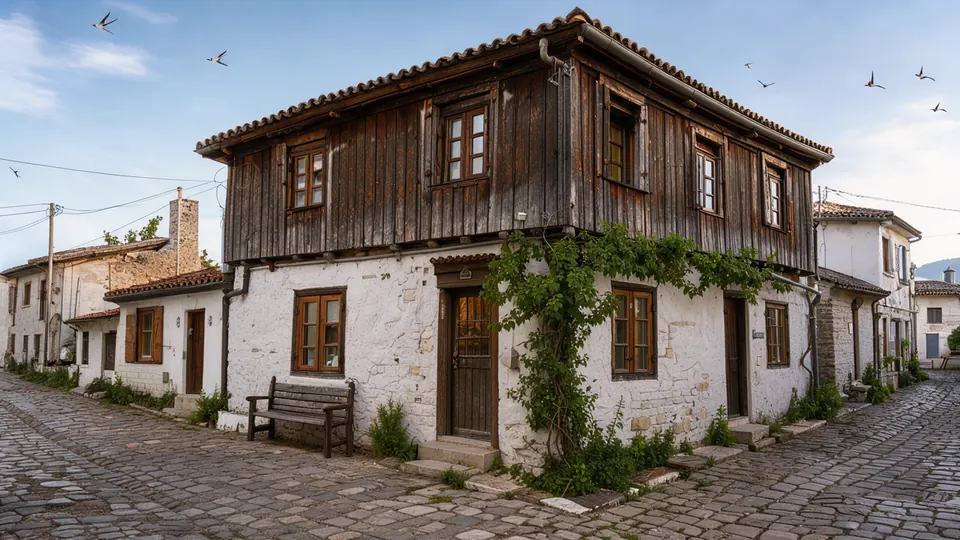
The 18th and 19th centuries saw the construction of the distinctive wooden houses that now characterize Old Nessebar's residential architecture. These "Revival-period" houses feature stone ground floors for storage and trade, with overhanging wooden upper stories used as living quarters. Their characteristic projecting bay windows (erkeri) and wooden balconies create the charming streetscapes that visitors admire today.
These houses belong to the era of the Bulgarian National Revival, a period of cultural, economic, and national awakening in the eighteenth and nineteenth centuries. The design was perfectly suited to a crowded peninsula and to a population of merchants and seafarers: the solid stone ground floor resisted damp and sea air and held shops, workshops, and stores for goods and fishing gear, while the timber upper floors, jettied out over the narrow lanes, gained extra living space and light. Wide eaves and rows of windows along the projecting erkeri caught the breeze and the sun, an intelligent response to the maritime climate. Inside, the living quarters were often arranged around a central hall, with built-in wooden cupboards and decorated ceilings. The overhanging erkeri and carved wooden balconies are now the signature image of the Old Town, and dozens of these houses survive, making Nessebar one of the finest ensembles of Black Sea Revival architecture anywhere.
Wine and Wealth
During this period, Nessebar also developed a thriving wine industry, with vineyards cultivated on the slopes around the peninsula. The city's wine was exported throughout the Ottoman Empire and became one of its primary sources of wealth.
Viticulture had ancient roots on this coast, reaching back to the Greek colonists who had shipped wine in clay amphorae, and the Ottoman-era trade revived that long tradition. Alongside fishing and seaborne commerce, wine gave the town a prosperous merchant class, whose wealth paid for the very Revival-period houses that line the streets today.
The End of Ottoman Rule
Ottoman rule over Nessebar ended in 1878, when the Russo-Turkish War of 1877-1878 led to the liberation of Bulgaria and the creation of a new Bulgarian state. The town's centuries as an Ottoman port were over, and it entered the modern era with its medieval churches and Revival houses largely intact, a heritage that would one day be recognised by the whole world.
What Visitors Can See Today
The most visible legacy of this period is the streetscape itself: dozens of wooden Revival-era houses with stone ground floors and projecting upper storeys line the cobbled lanes, and several are open as house-museums and the Ethnographic Museum, furnished in the style of nineteenth-century merchant families. Many of the medieval churches that survived Ottoman rule still stand throughout the Old Town. The wooden windmill near the isthmus and the general layout of shops, homes, and harbour reflect the town's long life as an Ottoman-era trading and seafaring community.
To explore this layered Old Town for yourself, see our guide to Nessebar.
Frequently Asked Questions
When did the Ottomans conquer Nessebar?
The Ottoman Turks took Nessebar in 1453, the same period in which Constantinople fell. Ottoman rule over the town lasted until 1878.
Did the Ottomans destroy Nessebar's churches?
No. Although a few churches were converted into mosques or fell into disrepair, the Ottomans generally tolerated the Christian population, and most of the medieval churches survived, which is why so many can still be seen today.
Who lived in Nessebar during the Ottoman period?
Greek Orthodox merchants and fishermen continued to form the majority of the population, keeping their faith and traditions under the Ottoman millet system, which granted Christian communities considerable self-government.
What are the Revival-period houses of Nessebar?
They are the distinctive 18th- and 19th-century wooden houses with stone ground floors and overhanging timber upper storeys, featuring projecting bay windows (erkeri) and balconies. They are the signature architecture of the Old Town.
When did Ottoman rule over Nessebar end?
It ended in 1878, when the Russo-Turkish War of 1877-1878 led to the liberation of Bulgaria, bringing some 425 years of Ottoman rule over the town to a close.
Get local stories & deals
One email a month with the best Black Sea stories and seasonal deals. No spam.