The Unconsecrated Jewel: The Legend and Architecture of St. John Aliturgetos
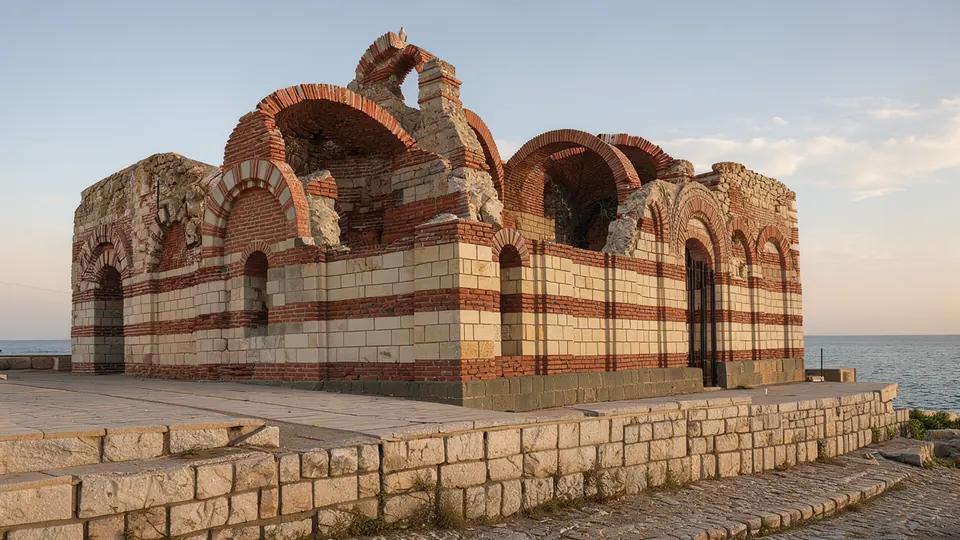
Perched dramatically on a rocky outcrop at the southern tip of Nessebar's ancient peninsula, the Church of St. John Aliturgetos stands as a hauntingly beautiful monument to the city's medieval zenith. Its name, derived from Greek, translates to "St. John the Unconsecrated," hinting at a dark legend that has shrouded the building in mystery for centuries. Though partially ruined, its remaining structure is a masterclass in the architectural and artistic brilliance of the Second Bulgarian Empire. As the waves of the Black Sea crash just metres away, the church's warm-toned stone and intricate brickwork catch the golden light of sunrise and sunset, making it arguably the most photogenic and evocative of all of Nessebar's sacred sites. It is a silent testament not only to immense faith and artistic ambition but also to the unforgiving power of nature and the enduring pull of local folklore.
Today, St. John Aliturgetos is admired as one of the finest examples of 14th-century Bulgarian church architecture, a period when the Tarnovo Artistic School reached its creative peak. The church embodies the so-called "picturesque" or ornamental style, which favoured dynamic, colourful facades over monolithic austerity. Its design is a complex cross-in-square (or cross-domed) structure, with a central dome once rising above the naos, supported by four columns. What truly captivates the observer, however, is the exterior decoration. The walls are a symphony of mixed masonry, a technique known as opus mixtum, where precisely cut blocks of white limestone alternate with horizontal bands of red brick. This basic pattern is then elaborated with an astonishing variety of decorative motifs. Blind arches, two-stepped niches, and intricate friezes break up the flat surfaces, creating a vibrant play of light and shadow. The most distinctive features are the glazed ceramic elements—circular and four-leafed rosettes, solar symbols, and chequerboard patterns—embedded into the masonry, which would have glittered like jewels in the sun. This decorative scheme, while sharing similarities with the nearby Church of Christ Pantocrator, is considered by many art historians to be even more refined and harmoniously executed in St. John Aliturgetos, representing the culmination of this unique architectural style.
The Legend of the Unconsecrated
The church's intriguing name, Aliturgetos, is not a reference to a saint or a biblical event, but to a tragic legend woven into the very fabric of its construction. As the story goes, during the final stages of the church's erection in the 14th century, one of the master builders fell from the scaffolding and was killed instantly. According to the strict canons of the Orthodox Church, a site where human blood has been shed in such a manner is considered desecrated and cannot be used for holy liturgy. Consequently, despite being completed as an architectural masterpiece, the church was never officially consecrated. No holy services were ever held within its walls. This powerful narrative transforms the building from a simple historical artefact into a place of poignant story. It speaks to a world where faith was governed by rigid, unbendable rules, and where a single moment of tragedy could render years of pious labour spiritually void. While the historical veracity of this tale is impossible to confirm, it has become an inseparable part of the church's identity, adding a layer of mystique and melancholy that deeply resonates with visitors who stand before its silent, hallowed-yet-unhallowed walls.
A Silent Witness to History
Art historians and archaeologists date the construction of St. John Aliturgetos to the mid-14th century, a time of immense cultural flourishing for the Second Bulgarian Empire, particularly during the reign of Tsar Ivan Alexander (1331-1371). Mesembria, as Nessebar was then known, was a vital commercial and cultural hub, a coveted prize contested between Bulgaria and the Byzantine Empire. The wealth pouring into the city funded the construction of dozens of magnificent churches, each a testament to the piety and prosperity of its citizens. St. John Alitorgetos was likely the main church (katholikon) of a monastery complex that has since disappeared. For several centuries, it stood as a landmark of faith and art, surviving the Ottoman conquest in 1453 and the subsequent decline of the city's political importance. Its greatest tragedy, however, came not from human conflict but from the earth itself. On March 14, 1913, a powerful earthquake struck the region, causing catastrophic damage to the church. Its dome collapsed, the supporting columns were destroyed, and the entire western part of the building was severely compromised. The ruin we see today is a direct result of this natural disaster. Extensive conservation and structural reinforcement works were undertaken during the 20th century to stabilise what remained, preserving this architectural jewel for future generations, albeit in its tragically fragmented form.
Visiting St. John Aliturgetos Today
For the modern visitor to Nessebar, the Church of St. John Aliturgetos is an unmissable highlight. While entry into the interior is not permitted due to its fragile state, the experience of circumnavigating its exterior is profoundly rewarding. The church is freely accessible, located at the end of a scenic path that winds along the southern coast of the Old Town, offering spectacular views of the sea. It is a paradise for photographers, who flock here to capture its intricate details against the dramatic backdrop of the Black Sea. The best light is typically during the 'golden hours' of early morning and late afternoon. Sunrise shots from the east, with the light catching the facade, are particularly stunning, while sunset offers a softer, warmer glow. The path leading from the church towards the Nessebar harbour provides the classic, postcard-perfect view of its southern and eastern facades. Take your time to walk around the entire structure, noticing the subtle variations in the brickwork patterns and searching for the colourful ceramic inlays that still cling to the walls. Visiting St. John Aliturgetos is more than just a historical sightseeing stop; it's a moment of reflection on the intersection of artistic genius, enduring faith, human tragedy, and the relentless passage of time.
Get local stories & deals
One email a month with the best Black Sea stories and seasonal deals. No spam.