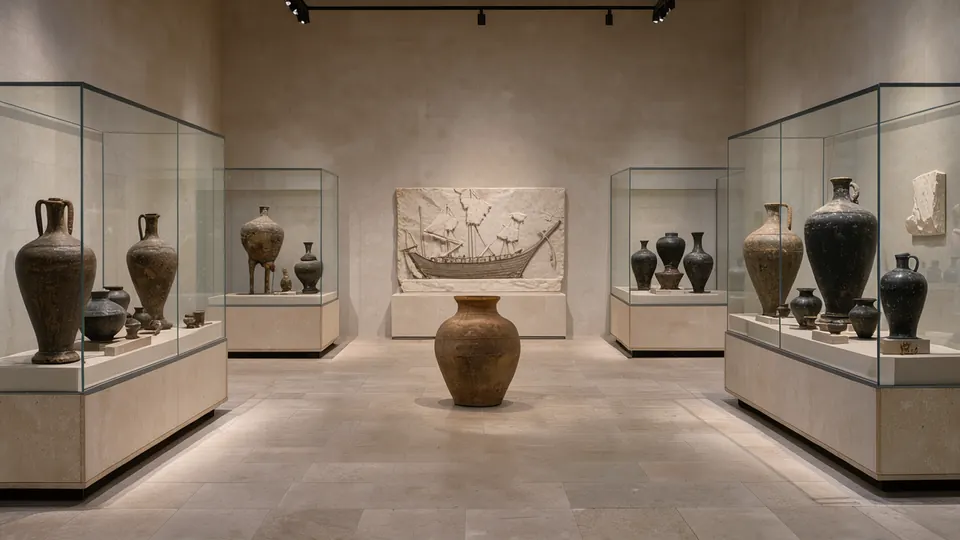
The Archaeological Museum of Nessebar, located at the entrance to the Old Town near the ancient fortifications, houses one of the most comprehensive collections of artifacts from the western Black Sea region. Founded in 1994, the museum tells the story of Nessebar from its earliest Thracian settlers to the present day, presenting in a single, well-organized building the layered history of a town that has been continuously inhabited for more than three thousand years.
A Museum at the Gateway to the Old Town
The museum's position is part of its appeal. Standing just inside the ancient fortifications, it greets visitors as they pass from the new town onto the historic peninsula, offering essential context before they explore the streets, churches, and houses beyond. Purpose-built to display the wealth of finds recovered from Nessebar and the surrounding sea and coast, the museum arranges its collection chronologically across several halls, so that a visitor moves through the eras in sequence.
A Collection Spanning Three Millennia
The museum's collection includes over 5,000 artifacts spanning three millennia. Among the highlights are Thracian gold jewelry, Greek pottery and coins from the Mesembria mint, Roman glass and bronze objects, and Byzantine religious art including icons and liturgical vessels. Together these objects trace the successive cultures that shaped the town known in antiquity as Mesembria.
Thracian and Greek Nessebar
The earliest layers of the collection belong to the Thracians, the region's original inhabitants, represented by finely worked gold jewelry and other prized possessions. With the arrival of Greek colonists, the settlement became the prosperous city of Mesembria, and the museum's Greek holdings include painted pottery and the coins struck at the city's own mint. The Mesembria coinage is of particular interest, as the right to mint coins marked the city's wealth and independence as a trading power on the Black Sea. The very name of the museum's collection is a reminder that the town's history reaches back long before the medieval churches for which it is best known, into an antiquity that ranks Mesembria among the oldest continuously inhabited towns on the European coast of the Black Sea.
Roman and Byzantine Layers
As the city passed under Roman and then Byzantine control, its material culture changed accordingly. Roman glass and bronze objects illustrate the refinement of daily life in the imperial period, while the Byzantine collection — including icons and liturgical vessels — reflects the town's transformation into a major Christian center, the role for which its many medieval churches are famous.
Seen in sequence, these layers turn the museum into a kind of compressed timeline. A visitor can stand before objects separated by a thousand years or more and grasp, in a few rooms, how one settlement was made and remade by Thracians, Greeks, Romans, Byzantines, and medieval Bulgarians, each leaving traces that the next built upon. Few towns of Nessebar's size can show such continuous occupation, and the museum's chronological arrangement is designed precisely to make that depth of history legible at a glance.
Treasures from the Sea
The museum's maritime archaeology section displays anchors, amphorae, and ship fittings recovered from shipwrecks near Nessebar, testifying to the city's importance as a maritime trading center throughout the ages. Set on a peninsula with a sheltered position on the coast, Nessebar was a natural harbor and a hub of seaborne commerce, and the goods that passed through it — wine, oil, and other commodities carried in clay amphorae — sometimes ended up on the seabed when ships were lost. These underwater finds give visitors a vivid sense of the trade routes that connected Nessebar to the wider ancient and medieval world.
The Icon Collection
The collection of medieval icons is particularly noteworthy, featuring works from the 13th to the 19th centuries that illustrate the evolution of Bulgarian religious art. These icons, rescued from Nessebar's many churches, represent some of the finest examples of icon painting in southeastern Europe. Arranged so that visitors can follow the development of style and technique across the centuries, they form a natural bridge between the museum and the living churches of the Old Town just beyond its doors.
What Visitors Can See Today
Today the Archaeological Museum remains the ideal first stop on any visit to Nessebar. Its halls present the full chronological sweep of the town's history — Thracian gold, Greek and Mesembrian coins, Roman and Byzantine objects, finds raised from the sea, and the celebrated icon collection — in a compact space that can be explored in an hour or so. An entrance fee of around five to six leva typically applies, with reduced rates often available for students, and the museum is generally open through the main visitor season; checking current hours before a visit is wise, especially outside the summer months.
Because the museum sits at the very entrance to the Old Town, it pairs naturally with a walking tour of the peninsula's churches and Revival-period houses, allowing visitors to connect the objects they have just seen with the streets and buildings where they were found. Many travelers find that an hour in the museum transforms the rest of their visit, because once the long story of Mesembria and Nessebar is understood, the fortifications, churches, and old houses outside stop being merely picturesque and become chapters in a single, three-thousand-year narrative.
For families and first-time visitors in particular, the compact, well-labeled galleries make the museum an approachable introduction rather than an exhausting one. The combination of gleaming gold, ancient coins, and objects raised from the seabed tends to hold the attention of younger and older visitors alike.
Frequently Asked Questions
When was the Archaeological Museum of Nessebar founded?
The museum was founded in 1994 and presents the history of Nessebar from its earliest Thracian settlers to the present day.
How many artifacts does the museum hold?
The collection includes over 5,000 artifacts spanning three millennia, organized chronologically across several halls.
What are the museum's most important exhibits?
Highlights include Thracian gold jewelry, Greek pottery and coins from the Mesembria mint, Roman glass and bronze, Byzantine religious art, underwater finds such as amphorae and anchors, and a celebrated collection of medieval icons.
How much does it cost to visit?
A modest entrance fee of around five to six leva typically applies, with reduced prices often available for students; it is best to confirm current prices and opening hours before visiting, especially out of season.
Where is the museum located?
It stands at the entrance to the Old Town, just inside the ancient fortifications, making it an ideal first stop before exploring the peninsula.
Begin your journey through three thousand years of history when you plan a visit to Nessebar.
Get local stories & deals
One email a month with the best Black Sea stories and seasonal deals. No spam.