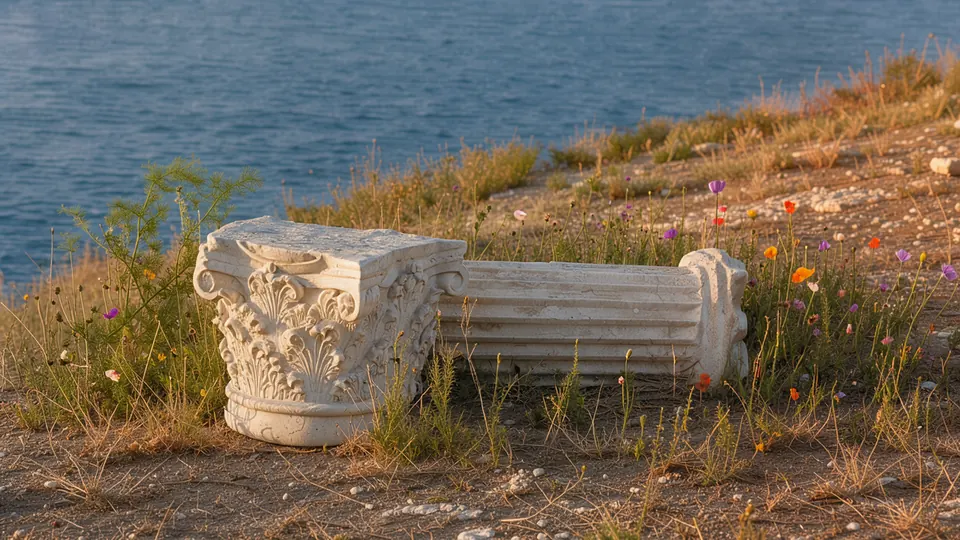
Mesembria Joins the Roman World
In 72 BC, Mesembria was incorporated into the Roman Empire following the campaigns of Marcus Lucullus. Under Roman rule, the city maintained its importance as a trading center and was granted the status of a civitas foederata (allied city), which allowed it to retain significant autonomy.
Marcus Terentius Varro Lucullus, brother of the more famous Lucius Lucullus, campaigned along the western Black Sea coast in 72-71 BC during Rome's wars against Mithridates VI of Pontus, the great enemy of the late Republic. The submission of the Greek Pontic cities brought Mesembria into the Roman orbit, though full and lasting Roman provincial control of the region was only consolidated in the following century. The Romans first organised the coast under the province of Moesia and, after the formal annexation of the Thracian kingdom in 45-46 AD under Emperor Claudius, the hinterland became the province of Thrace. As a civitas foederata, Mesembria preserved its Greek institutions, its assembly, and its right to mint coinage, governing its own internal affairs while accepting Roman supremacy in foreign and military matters. Greek remained the everyday language of the city throughout the Roman centuries, and its public life kept much of its Hellenic character even under imperial rule.
Prosperity Under Roman Rule
The Romans built new roads connecting Mesembria to other major cities in Thrace, improved the harbor, and constructed public buildings in the Roman architectural style. Archaeological excavations have uncovered remains of Roman thermal baths, mosaics, and inscriptions from this period.
Integration into the empire opened Mesembria's markets to the whole Mediterranean economy and brought the security of the Pax Romana, the long peace that allowed trade to flourish for generations. The Roman thermae, or public baths, were both a practical amenity and a symbol of urban civilisation, a place to bathe, exercise, and meet, heated by an under-floor hypocaust system. Floor mosaics and Greek and Latin inscriptions attest to a confident, cosmopolitan municipal life. The city continued to strike its own bronze coinage under several emperors, a visible sign of the autonomy it retained, and these civic issues are an important source for the city's history. Mesembria's harbour kept it connected to the great Roman ports of the Black Sea and the Aegean, exporting the produce of Thrace and importing the goods and fashions of the wider empire.
The Byzantine Flowering
When the Roman Empire split in 395 AD, Mesembria became part of the Eastern Roman Empire (Byzantine Empire). This marked the beginning of an era of extraordinary cultural and architectural flowering. The city became an episcopal see (bishop's seat) and experienced a boom in church construction.
The permanent division of the empire after the death of Theodosius I placed Mesembria firmly within the Greek-speaking, Christian East governed from Constantinople. As a bishopric, the city became a centre of ecclesiastical administration, and its wealth, piety, and prestige were expressed in stone and brick. Over the following centuries Mesembria changed hands several times between Byzantium and the medieval Bulgarian state, a contested prize whose possession was repeatedly disputed, yet through all these struggles its role as a great Christian port endured.
A Density of Churches
During the Byzantine period, over 40 churches were built in Mesembria - an astounding number for such a small area. Many of these churches survive to this day, making Nessebar one of the most important sites for the study of Byzantine architecture in southeastern Europe.
The surviving churches span many centuries and styles, from early basilicas to the richly ornamented later medieval churches faced with alternating stone, brick, and ceramic decoration. The earliest, the Old Metropolitan Church or Saint Sophia, was a great early Christian basilica begun as far back as the 5th-6th centuries. The later churches, built between the 10th and 14th centuries, belong to the so-called "picturesque" or cross-in-square style, their facades enlivened with bands of brick, white stone, blind arcades, ceramic rosettes, and green and yellow glazed discs set into the masonry. Among the best known are the Church of Christ Pantokrator, the Church of Saint John Aliturgetos rising dramatically above the harbour, the small Church of Saint Paraskeva, and the Church of Saint Stephen, also called the New Metropolitan Church, with its renowned frescoes. Together they make Nessebar an open-air textbook of Byzantine and medieval church architecture, found nowhere else in such concentration.
What Visitors Can See Today
A short walk through the Old Town leads past more surviving churches than almost anywhere else of comparable size. The ruined basilica of Saint Sophia stands near the centre, while the elaborately decorated Pantokrator and Saint John Aliturgetos churches showcase the colourful "picturesque style" of the late Byzantine and medieval period. The Church of Saint Stephen preserves extensive medieval frescoes inside, and the Archaeological Museum of Nessebar displays Roman baths finds, mosaics, inscriptions, and architectural fragments that bring the Roman and Byzantine city to life.
To plan a tour of these churches and ancient remains, see our guide to Nessebar.
Frequently Asked Questions
When did Mesembria become part of the Roman Empire?
Mesembria was incorporated into the Roman Empire in 72 BC following the campaigns of Marcus Lucullus, and was granted the status of a civitas foederata, an allied city with significant autonomy.
What does civitas foederata mean?
It means "allied city." This status allowed Mesembria to keep its Greek institutions, assembly, and the right to mint its own coins, governing its internal affairs while accepting Roman authority in military and foreign matters.
When did Mesembria become Byzantine?
When the Roman Empire was permanently divided in 395 AD, Mesembria became part of the Eastern Roman (Byzantine) Empire, governed from Constantinople, beginning a long era of cultural and architectural flourishing.
How many churches were built in Byzantine Mesembria?
Over 40 churches were built during the Byzantine period, an astonishing number for such a small peninsula. Many survive today, making Nessebar a key site for the study of Byzantine architecture.
What Roman remains can be seen in Nessebar?
Excavations have uncovered Roman thermal baths, mosaics, and inscriptions, finds from which are displayed in the Archaeological Museum of Nessebar.
Get local stories & deals
One email a month with the best Black Sea stories and seasonal deals. No spam.