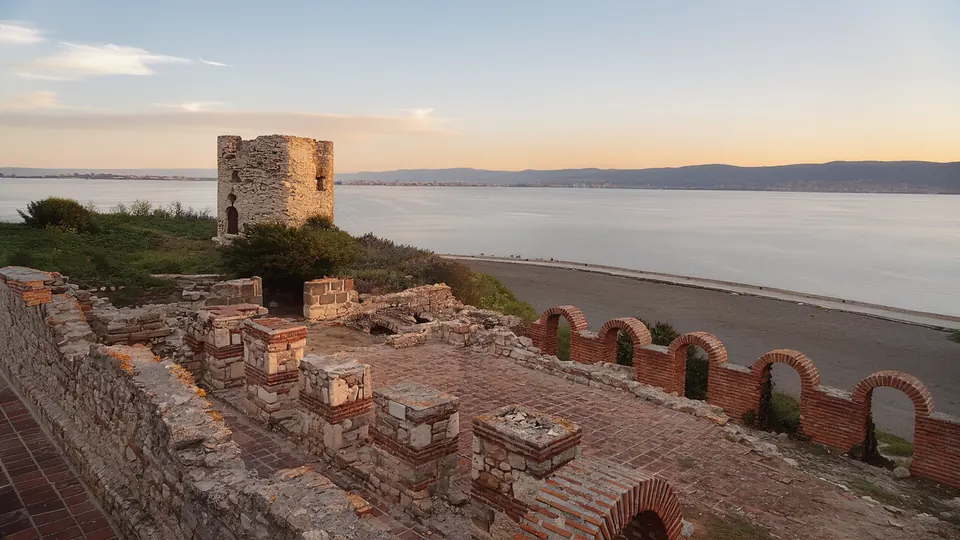
On the north shore of Old Nesebar stand the ruins of the early Christian Basilica of the Holy Virgin Eleusa. "Eleusa" is a Greek epithet of the Virgin; the Ancient Nessebar Museum also gives the church's Bulgarian name, Bogoroditsa Umilenie, and on its English page translates the epithet as "Tenderness". The basilica is among the earliest Christian churches in the town, and part of it has already fallen into the sea.
When was it built?
The sources do not give a single date:
- The Ancient Nessebar Museum gives the 6th century.
- The Nesebar Municipality tourist guide specifies the middle of the 6th century.
- The document "Values and Attributes of the Cultural Heritage of the Ancient City of Nessebar" (2026) dates it to the 5th–6th centuries and notes that it is thought to be the oldest church in Nesebar.
- The report of the joint World Heritage Centre/ICOMOS mission of 2023 places its construction in the 5th century and adds that the brick stamps date from the time of Emperor Justinian (527–565).
Architecture
According to the museum, the basilica has three aisles, three apses and a narthex (entrance hall). The two side aisles each have two further, smaller apses – to the north and to the south. It is 28 m long and 18 m wide. "Values and Attributes" adds that the church has no atrium (forecourt). The municipal guide notes that in plan the basilica resembles the Old Metropolis (St Sophia).
What to look for on site:
- The tombs in the narthex. Vaulted tombs survive there. The 2023 mission report speaks of the remains of five tombs, which have been looted.
- The shoreline. The north aisle and part of the central nave have fallen into the sea. "Values and Attributes" attributes this to the erosion of the coast.
- The reconstructed parts. In the 1980s the basilica was conserved and the collapsed north aisle was entirely rebuilt. Bulgaria's 2023–2024 state of conservation report to the World Heritage Centre notes that this restoration, more than 30 years ago, involved a hypothetical reconstruction that in places makes it harder to read the original.
Excavations and the monastery
Archaeological excavations began in 1920; according to the 2023 mission report they were led by Ivan Velkov. According to "Values and Attributes", the research shows that the church was rebuilt several times in the Middle Ages. At that time it was part of a monastery of the same name, which the written sources mention until the 14th century. The mission report adds that the monastery of the Holy Virgin Eleusa is mentioned in documents of Tsar Ivan Alexander (1331–1371).
According to the same report, the icon of the Holy Virgin Eleusa now on display in the National History Museum in Sofia is believed to come from this monastery. The municipal guide links the icon with the basilica and says that it was silver-plated by Tsar Ivan Alexander.
Around the basilica
Next to the basilica stands a 19th-century stone windmill. According to "Values and Attributes", only its stone part remains, without the characteristic timber top. It is one of the three surviving windmills of Nesebar – the other two are on the isthmus and in the mainland part of the town. You can read more about them in our article on the windmills of Nesebar.
The area around the church is rich in archaeology. Surveys in 2006–2007 in the north-eastern part of the peninsula, cited in the 2023 mission report, uncovered structures from the Early Classical period (first half to mid-5th century BC). A 2007 protocol of the then National Institute for Monuments of Culture described them as the earliest structures from the period of Greek colonisation studied so far at Mesambria. West of the basilica, structures from the Early Iron Age and the Classical period were found beneath Hellenistic and Early Byzantine walls.
Its place in the World Heritage site
The Ancient City of Nessebar was inscribed on the World Heritage List in 1983 under criteria (iii) and (iv). Criterion (iii) mentions religious buildings from Antiquity and medieval churches, some of which survive only as archaeological structures. The "Values and Attributes" document lists the Eleusa basilica, together with the Old Metropolis, among the Late Antique churches that it treats as attributes of the property's Outstanding Universal Value.
The UNESCO missions also point to problems. The 2023 report describes the multi-storey building put up in 2014–2015 right next to the basilica despite the moratorium on new construction requested by the World Heritage Committee, and considers it incompatible with the values of the property. According to the Bulgarian side, quoted in the report, a mortar-bonded wall and a stone footpath found during the 2010–2011 excavation of the plot are displayed on the ground floor of the building, but the mission notes that it is unclear how the structures were preserved in place and that it could not obtain clarification. The mission also notes that, after the coastal reinforcement works, the north shore around the monastery site has been turned into an area with car parks and sports facilities.
In the 2024 assessment included in the annex to the Vision for the Ancient City of Nessebar, Bogoroditsa Umilenie (Eleusa) is one of three churches in an emergency structural condition. The need for urgent work on the floor was already recorded in 2018, and the 2023 mission also recommends restoring the floor. A design brief for conservation and restoration work has been prepared.
How to find it
The basilica is on Kraybrezhna Street, on the north shore, in the north-eastern part of the peninsula. On the Ancient Nessebar Museum map it is number 14 and the windmill next to it is number 15. South-south-east of it is the Church of St Theodore, so the two are easy to visit together. Coming from the western part of the Old Town, you can pass St John the Baptist, St Spas and St Paraskeva on the way.
Visiting
The basilica does not appear in the Ancient Nessebar Museum's 2026 price list (read on 28 October 2026). The official sources we read give no opening hours or access conditions for the ruins, so check them with the museum.
Sources
- Ancient Nessebar Museum, Eleusa basilica (Bulgarian)
- Ancient Nessebar Museum, Basilica Holy Mother Eleusa (English)
- Ancient Nessebar Museum, the windmills (English)
- Ancient Nessebar Museum, map of the sights
- Ancient Nessebar Museum, 2026 ticket prices
- "Values and Attributes of the Cultural Heritage of the Ancient City of Nessebar", 2026 (PDF in Bulgarian, Nesebar Municipality)
- Annexes to the Shared Vision for the Ancient City of Nessebar (2026–2045), 27 January 2026 (PDF in Bulgarian, Nesebar Municipality)
- Nesebar Municipality, tourist guide (PDF in Bulgarian)
- NIICH, list of immovable cultural heritage in the town of Nesebar (XLS, June 2025)
- UNESCO World Heritage Centre, Ancient City of Nessebar
- Report of the joint World Heritage Centre/ICOMOS mission, January 2023 (PDF)
- Bulgaria's state of conservation report, 2023–2024 (PDF)
Checked on 28 October 2026.
Get local stories & deals
One email a month with the best Black Sea stories and seasonal deals. No spam.