Church of St Theodore (Sveti Todor) in Nesebar: History and Architecture
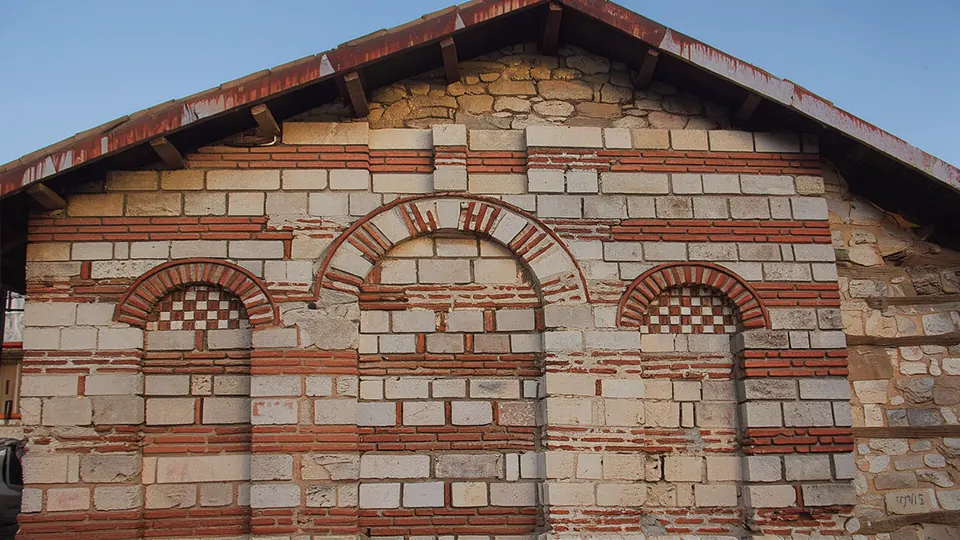
St Theodore (Sveti Todor in Bulgarian) is a small medieval church in the eastern part of Old Nesebar. Only the north and west facades survive from the original building, but they show the decorative style for which Nesebar's 13th–14th-century churches are known. Here it appears in a more modest form than on Christ Pantocrator or St John Aliturgetos, but it is well worth a close look.
When was it built: 13th or 14th century?
The official sources do not agree on a single date. The English page of the Ancient Nessebar Museum says the church was built in the 13th century and that the north and west facades date from that time, while the other walls and the roof are later. The document "Values and Attributes of the Cultural Heritage of the Ancient City of Nessebar" (2026) also dates it to the 13th century with a later reconstruction, and the annex to the Vision for the Ancient City of Nessebar specifies the second half of the 13th century. The Nesebar Municipality tourist guide gives the 13th century as well. The museum's own history page, however, lists St Theodore as a 14th-century church. The 1982 ICOMOS evaluation, on which the World Heritage inscription was based, places it in the series of Nesebar churches of the 13th and 14th centuries, together with St Paraskeva, the Holy Archangels Michael and Gabriel and St John Aliturgetos.
Architecture
According to the museum, St Theodore is a small single-nave church with a narthex and one apse. It is 8.70 m long and 4.15 m wide. The municipal tourist guide gives different measurements – about 11 m long and about 4 m wide – so treat them as approximate.
What to look at outside:
- Blind arches. The facades are articulated with blind arches of worked stone and brick.
- Ornament under the arches. The space beneath them is filled with chequerboard and zigzag patterns made of small stone blocks and bricks.
- Two periods in the masonry. According to the municipal guide, the north and west facades are built of worked sandstone blocks and three courses of brick, while the south and east walls are of stone with wooden beams (santrachi). The "Values and Attributes" document describes the masonry of the original facades as pseudo opus mixtum.
The same document notes that the picturesque style of the Tarnovo–Nesebar school is expressed in St Theodore to a lesser degree – on the north facade and partly on the west one. As representative of this style it names four churches: St John Aliturgetos, Saints Michael and Gabriel, St Paraskeva and Pantocrator.
Inside
According to "Values and Attributes", citing the study by the architect Alexander Rashenov, no wall paintings have been identified in the church. The municipal guide mentions a 17th-century iconostasis. Conservation work was carried out in the 1970s and 1980s, when the church was given a new roof.
Ship graffiti
According to Bulgaria's 2023–2024 state of conservation report to the World Heritage Centre, St Theodore is one of four Nesebar churches – with St Spas, St Stephen and St John Aliturgetos – that preserve more than 300 single or group graffiti of ships. There are also animals, people and buildings, and hundreds of personal names and years. The report calls them an important source on seafaring and shipbuilding on the western Black Sea coast. The programme to record them, involving the Centre for Underwater Archaeology, the Archaeological Museum in Nesebar and the Balkan Heritage Foundation, began in 2018; in 2023–2024 work continued on preparing their publication in catalogues.
Status and conservation
In the National Register of Immovable Cultural Heritage kept by the National Institute for Immovable Cultural Heritage (NIICH), St Theodore is listed as an architectural monument of national importance (State Gazette No. 41 of 1964). It had already been declared a "national antiquity" in 1927 (State Gazette No. 69 of 1927). The church is part of the Ancient City of Nessebar, inscribed on the UNESCO World Heritage List in 1983 under criteria (iii) and (iv). Criterion (iv) explicitly mentions medieval religious architecture with rich sculptural and polychrome decoration on the facades.
The joint World Heritage Centre/ICOMOS mission of January 2023 lists St Theodore among the churches around which new buildings of inappropriate scale and architecture have been put up. For its part, the municipality has installed technical devices that restrict car traffic around St Theodore, the Old Metropolis and St Stephen all year round. Terms of reference for the design of conservation and restoration work on the church have been agreed.
How to find it
According to the municipality's data in the list of the National Institute for Immovable Cultural Heritage (NIICH), the address is 1 Neptun Street. On the Ancient Nessebar Museum map the church is number 13: in the eastern part of the peninsula, east-north-east of the Old Metropolis (St Sophia) and south-south-east of the Basilica of the Holy Virgin Eleusa on the north shore. If you tour the churches from west to east – from St John the Baptist and St Spas through St Paraskeva – St Theodore and the Eleusa basilica make a convenient end to the walk.
Visiting
St Theodore is not one of the five churches managed by the Ancient Nessebar Museum (St Stephen, St Spas, Christ Pantocrator, St Paraskeva and St John the Baptist). The museum's 2026 price list (read on 28 October 2026) has no separate ticket for it; its name appears only in the description of one combined ticket. The official sources we read give no opening hours, so check with the museum whether and when the church is open before you go.
Sources
- Ancient Nessebar Museum, St Theodore church (Bulgarian)
- Ancient Nessebar Museum, The Saint Theodor Church (English)
- Ancient Nessebar Museum, history of the town (Bulgarian)
- Ancient Nessebar Museum, map of the sights
- Ancient Nessebar Museum, 2026 ticket prices
- "Values and Attributes of the Cultural Heritage of the Ancient City of Nessebar", 2026 (PDF in Bulgarian, Nesebar Municipality)
- Annexes to the Shared Vision for the Ancient City of Nessebar (2026–2045), 27 January 2026 (PDF in Bulgarian, Nesebar Municipality)
- Cultural Heritage Strategy of Nesebar Municipality 2023–2032 (PDF in Bulgarian)
- Nesebar Municipality, tourist guide (PDF in Bulgarian)
- NIICH, list of immovable cultural heritage in the town of Nesebar (XLS, June 2025)
- UNESCO World Heritage Centre, Ancient City of Nessebar
- ICOMOS evaluation of the nomination, 1982 (PDF)
- Report of the joint World Heritage Centre/ICOMOS mission, January 2023 (PDF)
- Bulgaria's state of conservation report, 2023–2024 (PDF)
Checked on 28 October 2026. Opening hours and prices change, so check them before you visit.
Get local stories & deals
One email a month with the best Black Sea stories and seasonal deals. No spam.