Church of St John the Baptist in Nesebar: History and Architecture
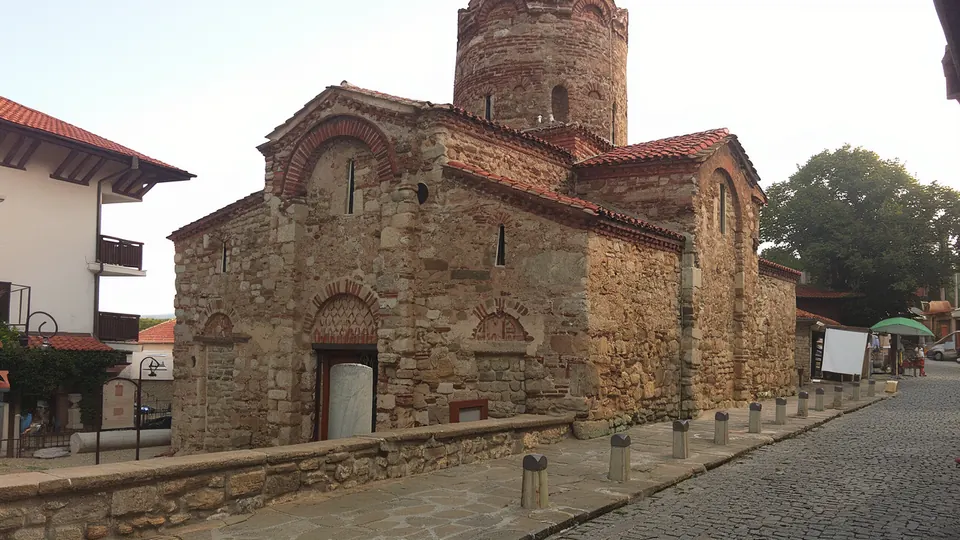
The Church of St John the Baptist (Sveti Yoan Krastitel in Bulgarian) is one of the earliest medieval churches in Old Nesebar to survive in its full volume. It was built around the 10th century (the official texts give dates between the 9th and the 11th century) on the foundations of an even older, 6th-century basilica. Today it is one of the sites of the Ancient Nessebar Museum and the starting point of the completed section of the "Spiritual Path" cultural and tourist route.
When was it built? What the sources say
The official texts do not give a single date. The Ancient Nessebar Museum's page on the church and the document "Values and Attributes of the Cultural Heritage of the Ancient City of Nessebar" (2026) give the 10th century; elsewhere the same document includes it among the seven medieval churches built between the 11th and 14th centuries. In its history of the town the museum places the church in the 11th century and describes it, together with St Stephen, as the prototype of Nesebar's later churches of the 13th–14th centuries. The Nesebar Municipality tourist guide gives the late 10th to early 11th century, and the annexes to the Vision for the Ancient City of Nessebar (2026) give the 10th century in one place and the 9th–10th century in another. For this reason we date it broadly to around the 10th century.
Under the church: a 6th-century basilica
In 2013, in connection with the restoration project for the church, rescue excavations were carried out (the museum's English page says 2012–2013). They showed that the cross-domed church stands on the foundations of a Late Antique three-aisled basilica. In its original plan the basilica had a single apse, semicircular inside and out. Later, two small semicircular apses were added to the south aisle and probably to the north aisle. On the basis of the plan and the finds, the museum dates the basilica to the 6th century. According to Bulgaria's 2023–2024 state of conservation report to the World Heritage Centre, its outline has been marked on the ground.
Architecture: what to look at
The church is built of rubble stone and mortar and measures 14 × 10 m. The museum describes it as a typical example of the transition from the shortened basilica to the cross-domed church. It has no narthex.
- The dome. Above the centre, on an inscribed circle, rises a cylindrical drum topped by a hemispherical dome.
- The three apses. To the east the church ends in three semicircular apses.
- The blind arches. The west, north and south facades are each articulated by one tall blind arch.
- The brick decoration. Early decorative elements in brick can be seen around the windows and above the entrance.
- The interior. The municipal guide describes the interior as divided by two longitudinal walls into three aisles covered with barrel vaults.
The wall paintings
Inside, the church was plastered and painted throughout. Two fragments survive today: a donor portrait from the 14th century on the south wall and a scene with St Marina from the 17th century on the south-west column. This is how the museum's Bulgarian page and "Values and Attributes" describe it; the museum's English page speaks of the south-east column.
Its place in the World Heritage site
The Ancient City of Nessebar was inscribed on the World Heritage List in 1983 under criteria (iii) and (iv). Criterion (iv) explicitly mentions the development of medieval religious architecture with rich sculptural and polychrome decoration on the facades. The 1982 ICOMOS evaluation, on which the inscription was based, mentions St John the Baptist among the town's outstanding monuments; at that time it housed the archaeological museum. In the National Register of Immovable Cultural Heritage the church is listed as an architectural monument of national importance (State Gazette No. 41 of 1964); it had already been declared a "national antiquity" in 1927 (State Gazette No. 69 of 1927).
The church was restored under Nesebar Municipality's pilot project "Faith in Nesebar", funded under the Regional Development Operational Programme 2007–2013, together with St Paraskeva and the landscaping of the spaces around the two churches. The joint World Heritage Centre/ICOMOS mission of January 2023 noted the successful treatment of the church's surroundings. It also recorded chronic damp, cracks badly filled during the restoration, traces of moisture along the plinth and inadequate climate control for the wall paintings, as well as an unsuitable tall hotel right next to the church. The annex to the Vision for the Ancient City of Nessebar (2026) recommends completing the restoration of the wall paintings, repairing the defects left by the earlier restoration and installing proper drainage.
How to find it
According to the municipality's data in the list of the National Institute for Immovable Cultural Heritage (NIICH), the address is 15 Mitropolitska Street. On the Ancient Nessebar Museum map the church is number 6, in the western half of the peninsula, north-east of Christ Pantocrator. Immediately to the north are the Early Byzantine baths, which the museum dates to the 6th century, the reign of Emperor Justinian I (the municipal guide places them north-east of the church), and to the east is the Church of St Spas. From here the completed section of the "Spiritual Path" route leads to St Paraskeva and the Holy Archangels Michael and Gabriel. Further east are St Theodore and the Basilica of the Holy Virgin Eleusa.
Visiting
- Tickets (museum price list for 2026, read on 28 October 2026): €2.56 for adults and €1.53 for children; for organised groups €2.05 and €1.02. The church is also included in the museum's combined tickets.
- Opening hours: at the time of checking, the museum's website shows only the 2025 timetable. In it St John the Baptist, St Spas and St Paraskeva are open daily from 1 April to 12 October with a lunch break (from 2 June to 14 September 10:30–14:00 and 14:30–19:00), and by appointment for the rest of the year. Check the current hours with the museum.
- What is inside: according to the annex to the Vision for the Ancient City of Nessebar (2026), the church houses an exhibition of icons from the museum's collection.
Sources
- Ancient Nessebar Museum, St John the Baptist church (Bulgarian)
- Ancient Nessebar Museum, The Saint John the Baptist Church (English)
- Ancient Nessebar Museum, Early Byzantine baths (Bulgarian)
- Ancient Nessebar Museum, history of the town (Bulgarian)
- Ancient Nessebar Museum, map of the sights
- Ancient Nessebar Museum, 2026 ticket prices
- Ancient Nessebar Museum, opening hours (2025 timetable)
- "Values and Attributes of the Cultural Heritage of the Ancient City of Nessebar", 2026 (PDF in Bulgarian, Nesebar Municipality)
- Annexes to the Shared Vision for the Ancient City of Nessebar (2026–2045), 27 January 2026 (PDF in Bulgarian, Nesebar Municipality)
- Cultural Heritage Strategy of Nesebar Municipality 2023–2032 (PDF in Bulgarian)
- Nesebar Municipality, tourist guide (PDF in Bulgarian)
- NIICH, list of immovable cultural heritage in the town of Nesebar (XLS, June 2025)
- UNESCO World Heritage Centre, Ancient City of Nessebar
- ICOMOS evaluation of the nomination, 1982 (PDF)
- Report of the joint World Heritage Centre/ICOMOS mission, January 2023 (PDF)
- Bulgaria's state of conservation report, 2023–2024 (PDF)
Checked on 28 October 2026. Opening hours and prices change, so check them before you visit.
Get local stories & deals
One email a month with the best Black Sea stories and seasonal deals. No spam.