The Windmills of Nesebar: the Isthmus Mill and the Stone Mill
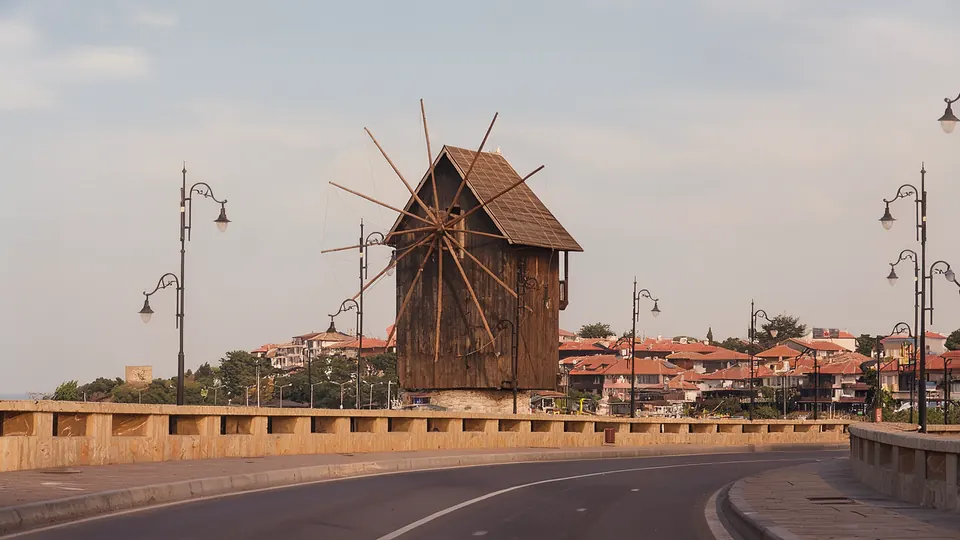
Everyone who comes to Nesebar knows the picture: a dark wooden windmill with large sails on the narrow isthmus that links the Old Town to the mainland. It is one of the best-known sights in the town. Its story, and the story of the mills that once stood around it, is about how the town ground its grain in the 19th century, when strong winds blew over the peninsula almost all year round.
Many mills, three left
The Ancient Nessebar Museum writes that many windmills were built in Nesebar in the 19th century, together with the Revival-period houses, and that the local people made good use of the strong winds that blow over the small peninsula nearly all year. Three of them survive: one in the middle of the isthmus, one on the north shore of the peninsula and one at the start of the new town.
The municipality's 2026 heritage documents list the mills among the town's buildings from the Ottoman period. Only two of the three are protected as immovable cultural heritage: the mill on the isthmus and the stone mill next to the Basilica of the Holy Virgin Eleusa. Both stand inside the boundaries of the World Heritage site. The third is in the buffer zone around it.
The museum describes two types of mill. Some were built entirely of stone, cylindrical, with a conical wooden roof. Others have a cylindrical stone ground floor with a rectangular or square wooden room above it and a two-sloped roof.
The mill on the isthmus
The mill you see on the isthmus is not the original one. According to the annexes to the municipality's Shared Vision for the Ancient City of Nessebar (2026), it stands on the widened part of the isthmus, on the site of a Revival-period windmill that was built on a quadrangular medieval tower. The present mill was rebuilt in 1968 from surviving archive documents.
The municipal tourist guide gives a different history: the mill survived from Ottoman times, collapsed in 1929 and was put up again after 1944. According to the guide, its base is stone and its upper part is wood. Both versions agree that what stands today is a 20th-century reconstruction.
In 2022 the municipality paid for a project to conserve and restore the mill and open it to visitors. In 2023 the mill housed the exhibition "The Riches of the Ancient Necropolis of Mesambria". The 2024 assessment in the same annexes rates it in good technical condition and not at risk. There is more on the isthmus itself, its harbours and the town gate in our article on the Nesebar isthmus.
The stone mill by the Eleusa basilica
On the north shore of the peninsula, next to the ruins of the Basilica of the Holy Virgin Eleusa, stands the other protected mill, the stone one. The museum describes the all-stone mills as cylindrical with a conical wooden roof; this one has no roof today.
The 2026 annexes rate it in poor technical condition and at risk. The missing roof makes it hard to protect the masonry. The annexes say a project for its conservation, restoration and display is needed and class the work as urgent because of the critical state of the structure.
How the mills used the wind
The museum notes that the large wooden vanes of Nesebar's mills always face the direction of the strongest winds. Otherwise mills of this kind worked like windmills elsewhere in Europe: the sails turned a shaft, gears passed the movement on to a pair of millstones, and grain fed between the stones came out as flour. The museum and the municipality do not publish a detailed description of the machinery of Nesebar's mills, so we do not give one here.
Visiting
- The isthmus mill. You pass it on the way into the Old Town. It is one of the sites of the Ancient Nessebar Museum: according to the museum's 2026 price list, an individual ticket costs €2.56 for adults and €1.53 for children.
- The stone mill. It is on the north shore, in the north-eastern part of the peninsula, next to the Eleusa basilica. On the Ancient Nessebar Museum map the basilica is number 14 and the windmill is number 15.
Sources
- Ancient Nessebar Museum, the windmills (English)
- Ancient Nessebar Museum, 2026 ticket prices
- "Values and Attributes of the Cultural Heritage of the Ancient City of Nessebar", 2026 (PDF in Bulgarian, Nesebar Municipality)
- Annexes to the Shared Vision for the Ancient City of Nessebar (2026–2045), 27 January 2026 (PDF in Bulgarian, Nesebar Municipality)
- Nesebar Municipality, tourist guide (PDF in Bulgarian)
Checked on 29 October 2026. Prices change, so check them before you travel.
Get local stories & deals
One email a month with the best Black Sea stories and seasonal deals. No spam.