Church of the Holy Saviour (Sveti Spas) in Nesebar: 17th-Century Murals
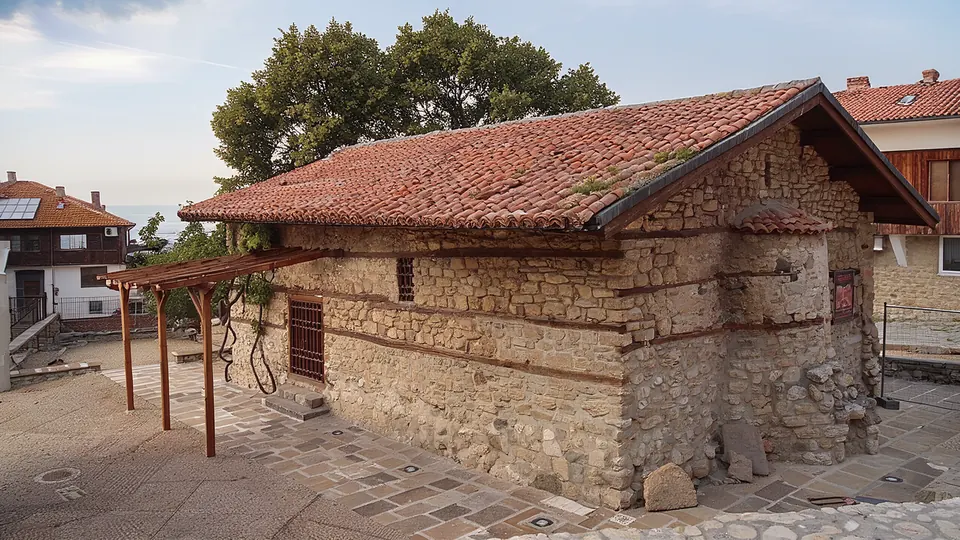
The Church of the Holy Saviour (Sveti Spas in Bulgarian) is a small church in Old Nesebar, built in the early 17th century, during Ottoman rule. From the outside it is a single-nave, single-apse building with a timber roof with eaves, while its interior is entirely covered with wall paintings from the same century. Today the church is one of the sites of the Ancient Nessebar Museum. In the Nesebar Municipality tourist guide it also appears as the Church of the Ascension (Vaznesenie Gospodne), and in the NIICH list, in the entry for its 1927 declaration as a "national antiquity", as "Church of the Ascension" (Tsarkvata Vaznesenie).
When was it built?
According to the Ancient Nessebar Museum, the church was built in 1609 with funds from a wealthy citizen of Nesebar, in the time of Metropolitan Kiprian. This is known from the donor's inscription above the south entrance. The municipal tourist guide reports it slightly differently: the church was put up in the early 17th century on the ruins of an older church, and in 1609 it was painted at the expense of a local archon, that is, a well-to-do citizen. In Bulgaria's 2023–2024 state of conservation report to the World Heritage Centre one photo caption gives the year 1604, but all the other official texts we read link the church with 1609.
Architecture
St Spas is a single-nave, single-apse church, 11.70 m long and 5.70 m wide. A long, narrow narthex once ran along its whole north side, bringing the width of the building to 9.80 m. The roof is a timber roof with eaves and no ceiling boarding inside. The east facade was half sunk into the ground – the document "Values and Attributes of the Cultural Heritage of the Ancient City of Nessebar" (2026) also notes that the church was partly sunk into the ground.
The wall paintings
The interior was painted entirely by an unknown master in the early 17th century. The paintings show episodes from the lives of Christ and the Virgin. In the apse is the Virgin "Wider than the Heavens" with the Child – the type that the museum's English page calls the Virgin Platytera.
"Values and Attributes" notes that the Nesebar school of icon painting reached its peak in the 16th–17th centuries, and counts the paintings of St Spas among the surviving examples of church painting in the town, together with those in St Stephen and St John the Baptist. According to a 1950 study (Vasiliev) cited in the same document, a similar arrangement of wall paintings existed in the Nesebar church of St George the New, demolished in 1937.
Ship graffiti
According to Bulgaria's 2023–2024 state of conservation report, St Spas is one of four Nesebar churches – with St Theodore, St Stephen and St John Aliturgetos – that preserve more than 300 single or group graffiti of ships. Besides ships there are incised animals, people and buildings, and hundreds of personal names and years. Among the examples in "Values and Attributes" is a graffito of a four-masted merchant clipper of the mid-19th century from St Spas itself. The UNESCO advisory mission of 2017 noted conservation problems in this church related to the roof, and that the painted plaster immediately around the graffiti had already begun to deteriorate.
The tombstone of Mataisa Kantakouzene Palaiologina
For many years the tombstone of the Byzantine princess Mataisa Kantakouzene Palaiologina lay in the floor of the church. According to "Values and Attributes", it is recorded in drawings by Sayger and Desarnod from 1829–1830. Today it is no longer in the church but in the Archaeological Museum in Nesebar.
Around the church
Archaeological work next to the church uncovered a Hellenistic house: about 3 m below today's ground level a basement room, the stairway down to it and the well of a peristyle (a colonnaded courtyard) were found. The house has been excavated and recorded, and by 2024 its position was marked in the paving. The space around the church has been landscaped and is part of the "Spiritual Path" cultural and tourist route.
Condition and status
In Bulgaria's 2023–2024 state of conservation report, St Spas is among the churches for which urgent measures have been set; drainage problems are mentioned. The annexes to the Vision for the Ancient City of Nessebar (2026) cite the NIICH assessment of 2018, according to which St Spas needs urgent interventions – drainage and climate control. In the National Register of Immovable Cultural Heritage the church is listed as an architectural monument of national importance (State Gazette No. 41 of 1964); it had already been declared a "national antiquity" in 1927 (State Gazette No. 69 of 1927). It is part of the Ancient City of Nessebar, inscribed on the UNESCO World Heritage List in 1983.
How to find it
According to the municipality's data in the list of the National Institute for Immovable Cultural Heritage (NIICH), the address is 1 Briz Street. On the Ancient Nessebar Museum map the church is number 7: immediately east of St John the Baptist and east-south-east of the Early Byzantine baths. North-east of it are the Holy Archangels Michael and Gabriel and St Paraskeva, so the three churches are easy to visit together.
Visiting
- Tickets (museum price list for 2026, read on 28 October 2026): €2.56 for adults and €1.53 for children; for organised groups €2.05 and €1.02. There is also a combined ticket for St Stephen and St Spas – €6.14 for adults and €3.07 for children.
- Opening hours: at the time of checking, the museum's website shows only the 2025 timetable. In it St Spas, St Paraskeva and St John the Baptist are open daily from 1 April to 12 October with a lunch break (from 2 June to 14 September 10:30–14:00 and 14:30–19:00), and by appointment for the rest of the year. Check the current hours with the museum.
Sources
- Ancient Nessebar Museum, St Spas church (Bulgarian)
- Ancient Nessebar Museum, The Saint Spass Church (English)
- Ancient Nessebar Museum, map of the sights
- Ancient Nessebar Museum, 2026 ticket prices
- Ancient Nessebar Museum, opening hours (2025 timetable)
- "Values and Attributes of the Cultural Heritage of the Ancient City of Nessebar", 2026 (PDF in Bulgarian, Nesebar Municipality)
- Annexes to the Shared Vision for the Ancient City of Nessebar (2026–2045), 27 January 2026 (PDF in Bulgarian, Nesebar Municipality)
- Nesebar Municipality, tourist guide (PDF in Bulgarian)
- NIICH, list of immovable cultural heritage in the town of Nesebar (XLS, June 2025)
- Bulgaria's state of conservation report, 2023–2024 (PDF)
- Report of the UNESCO/ICOMOS advisory mission, 2017 (PDF)
- UNESCO World Heritage Centre, Ancient City of Nessebar
Checked on 28 October 2026. Opening hours and prices change, so check them before you visit.
Get local stories & deals
One email a month with the best Black Sea stories and seasonal deals. No spam.