Church of St Paraskeva in Nesebar: History and Architecture
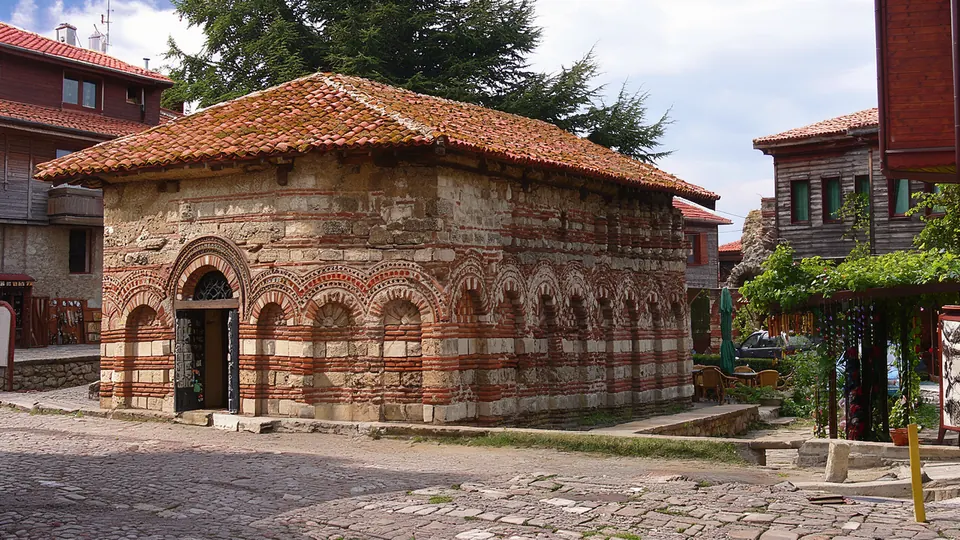
St Paraskeva is a medieval church in Old Nesebar, known for the decoration of its facades in stone, brick and glazed ceramics. Today it is one of the sites of the Ancient Nessebar Museum and houses the exhibition "Saved Murals from Nesebar Churches" (on the museum's English page: "Surviving murals from lost Nessebar churches"). In the NIICH list, in the entry for its 1927 declaration as a "national antiquity", the church is recorded as St Petka.
Dating
The Ancient Nessebar Museum dates the church to the 13th–14th centuries. In its history of the town the museum places it in the 13th century – the period when Nesebar was part of the Bulgarian state (1201–1263) – among the churches with direct parallels in the architecture of the capital, Tarnovo. The document "Values and Attributes of the Cultural Heritage of the Ancient City of Nessebar" (2026) also gives the 13th–14th centuries, while the Cultural Heritage Strategy of Nesebar Municipality gives the 13th century. The 1982 ICOMOS evaluation, on which the World Heritage inscription was based, mentions it among the series of Nesebar churches of the 13th and 14th centuries.
Architecture
According to the museum, St Paraskeva is a single-nave church with a narthex, measuring 15 × 6 m. To the east it ends in a five-sided apse. It is built of dressed stone and brick in alternating bands. The museum notes that the church rose in height as a typical cross-domed building: the cross can be read in the roof, and above the centre stood a drum with a dome. Over the narthex there was a bell tower, as shown by the stone staircase built into the wall between the nave and the narthex. The present gabled roof is a later addition.
The municipality's Cultural Heritage Strategy describes St Paraskeva and St Theodore more generally, as single-nave, single-apse churches with a barrel vault. It does not mention the dome or the bell tower, so here we follow the museum's more detailed description.
What to look at on the facades
- Blind arches. A row of blind arches with richly decorated tympana – the semicircular fields under the arches – runs along the north and south facades.
- Stone and brick patterns. The tympana are filled with herringbone, sun, zigzag, chequerboard and other motifs.
- Ceramic "saucers". Above the arches, bands of four-lobed and round glazed ceramic pieces are set into the wall. "Values and Attributes" notes that the ceramic elements were fixed in various ways on Nesebar's churches; one method was to set them into specially shaped hollows in the plaster.
- The apse. Walk round to the east side to see the five-sided apse.
"Values and Attributes" counts St Paraskeva among the four churches representative of the Tarnovo–Nesebar school in the Byzantine style, together with St John Aliturgetos, Saints Michael and Gabriel and Pantocrator.
The exhibition "Saved Murals from Nesebar Churches"
The church shows, for the first time, wall paintings from the Church of St George the Elder, demolished in 1958. That church stood in the south-eastern part of Old Nesebar; it had a single nave and a narthex and was built in 1704. Its paintings date from the early 18th century. Before the demolition they were taken down, and most were moved to the National Archaeological Museum in Sofia; a small part stayed in Nesebar. That part is on display here, together with some of the paintings removed from the Church of St Clement. According to "Values and Attributes", the paintings of St George the Elder were devoted mainly to St George – scenes from his life, medallions with saints and full-length figures of saints.
The same document gives the background: several Nesebar churches built from the early 18th century onwards, more modest in architecture and decoration, were judged to be "of no particular value" and were demolished in the mid-20th century when a regulation plan was implemented.
Restoration
St Paraskeva was restored under Nesebar Municipality's pilot project "Faith in Nesebar", which covered the conservation of Nesebar churches, the landscaping of the spaces around them and a cultural and tourist route. The project was funded under the Regional Development Operational Programme 2007–2013. The UNESCO/ICOMOS advisory mission of 2017 considered the new protective roof a success in many ways, but noted that without rainwater goods there were signs of rising damp. The January 2023 mission described the restoration with the added metal roof as controversial. The annex to the Vision for the Ancient City of Nessebar (2026) recommends repairing the defects left by the restoration and assessing the interior climate.
Its place in the World Heritage site
The Ancient City of Nessebar was inscribed on the World Heritage List in 1983 under criteria (iii) and (iv). Criterion (iv) explicitly mentions medieval religious architecture with rich sculptural and polychrome decoration on the facades – exactly the kind of decoration you see on St Paraskeva. In the National Register of Immovable Cultural Heritage the church is listed as an architectural monument of national importance (State Gazette No. 41 of 1964); it had already been declared a "national antiquity" in 1927 (State Gazette No. 69 of 1927).
How to find it
According to the municipality's data in the list of the National Institute for Immovable Cultural Heritage (NIICH), the address is 36 Mitropolitska Street. On the Ancient Nessebar Museum map the church is number 10, in the northern half of the peninsula, immediately east of the Holy Archangels Michael and Gabriel. To the east-south-east is St Demetrius, and to the south-east the Old Metropolis (St Sophia). The completed section of the "Spiritual Path" route runs from St John the Baptist to St Paraskeva and the Holy Archangels. Between them lies St Spas, and further east are St Theodore and the Basilica of the Holy Virgin Eleusa.
Visiting
- Tickets (museum price list for 2026, read on 28 October 2026): €2.56 for adults and €1.53 for children; for organised groups €2.05 and €1.02. The church is also included in the museum's combined tickets.
- Opening hours: at the time of checking, the museum's website shows only the 2025 timetable. In it St Paraskeva, St Spas and St John the Baptist are open daily from 1 April to 12 October with a lunch break (from 2 June to 14 September 10:30–14:00 and 14:30–19:00), and by appointment for the rest of the year. Check the current hours with the museum.
Sources
- Ancient Nessebar Museum, St Paraskeva church (Bulgarian)
- Ancient Nessebar Museum, The Saint Paraskeva Church (English)
- Ancient Nessebar Museum, history of the town (Bulgarian)
- Ancient Nessebar Museum, map of the sights
- Ancient Nessebar Museum, 2026 ticket prices
- Ancient Nessebar Museum, opening hours (2025 timetable)
- "Values and Attributes of the Cultural Heritage of the Ancient City of Nessebar", 2026 (PDF in Bulgarian, Nesebar Municipality)
- Annexes to the Shared Vision for the Ancient City of Nessebar (2026–2045), 27 January 2026 (PDF in Bulgarian, Nesebar Municipality)
- Cultural Heritage Strategy of Nesebar Municipality 2023–2032 (PDF in Bulgarian)
- NIICH, list of immovable cultural heritage in the town of Nesebar (XLS, June 2025)
- UNESCO World Heritage Centre, Ancient City of Nessebar
- ICOMOS evaluation of the nomination, 1982 (PDF)
- Report of the UNESCO/ICOMOS advisory mission, 2017 (PDF)
- Report of the joint World Heritage Centre/ICOMOS mission, January 2023 (PDF)
Checked on 28 October 2026. Opening hours and prices change, so check them before you visit.
Get local stories & deals
One email a month with the best Black Sea stories and seasonal deals. No spam.