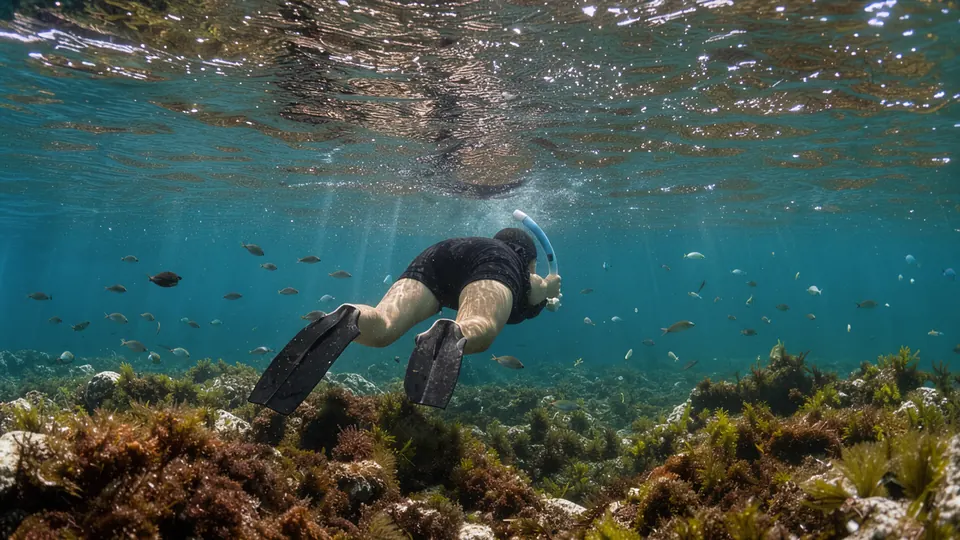
The Black Sea around Nesebar offers unique diving experiences. While it lacks tropical reefs, the underwater world has its own charm — ancient shipwrecks, rocky formations, and marine life found nowhere else.
You do not come here for colour. You come for what lies on the bottom: walls, amphora fragments, anchors and rock smoothed by millennia of swell. Nesebar is one of the few towns in Europe whose historic centre continues below the waterline, because part of ancient Mesembria sank as sea level rose and the coast eroded.
Why the Black Sea is different
Salinity comes first. Large rivers pour in and the link to the ocean is narrow, so the water is markedly less salty than the Mediterranean: slightly less buoyancy, marginally less lead than further south, a much shorter species list and no coral reefs at all.
Depth comes second. Below roughly 150–200 m the water is effectively without oxygen and saturated with hydrogen sulphide. Nothing lives there to eat timber, which is why extraordinarily well-preserved ancient ships lie on the Black Sea floor — far beyond recreational depths, reached only by scientific expeditions. See the Black Sea: nature, marine life and environmental facts.
Diving conditions
- Visibility: 5–15 meters (best in June and September)
- Water temperature: 20–26 °C in summer at surface, 10–15 °C below 15 m
- Current: generally mild
- Best season: June–September
The thermocline, explained
The drop from 24 °C at the surface to 12 °C at fifteen meters is not gradual. It happens across one narrow layer, the thermocline, crossed in seconds and sometimes visible as a shimmer. So a 5 mm wetsuit is not overkill in August, plan shorter bottom times than the surface suggests, and carry a torch. See also sea temperature and jellyfish in Nesebar.
Dive sites
Cape Emine (30 km north): Rocky formations with caves and overhangs. Depth 5–25 m. Home to Black Sea turbot, blenny, and crabs. The most popular site, and worth a land visit too.
Nesebar Peninsula: Shallow dives (3–8 m) along the old town walls, with ancient amphora fragments and Ottoman-era ship remnants. Great for beginners.
Sozopol area (70 km south): Several wreck sites from WWII. Depth 15–30 m. For experienced divers.
| Site | Depth | Level |
|---|---|---|
| Nesebar Peninsula | 3–8 m | beginner |
| Cape Emine | 5–25 m | beginner to intermediate |
| Sozopol area | 15–30 m | experienced, wreck-capable |
Sunken Mesembria and the rules that apply
Part of the ancient city lies underwater off the peninsula: fortification stretches, harbour structures, anchors and amphora fragments. This is an archaeological site, not a souvenir shop, and the rule has no exceptions: take nothing and move nothing. Removing or disturbing finds is illegal, and organised diving on protected underwater heritage requires the proper permissions. Dive with a licensed local centre and leave everything on the seabed. Read the story behind those finds in diving in the waters of ancient Nessebar and the sunken city.
Snorkeling
No certification needed — just mask, snorkel, and fins:
- Rocky areas near Old Nesebar: best for seeing fish, crabs, and underwater rock formations
- Cape Emine: crystal-clear water with visibility up to 15 m on calm days
- Bring water shoes — rocky entry points require foot protection
Snorkeling looks harmless, which is why it gets underestimated. Never go alone, judge the swell before stepping onto wet rock, and watch which way the wind pushes you — coming back against it is far harder than drifting out. Stay clear of boat lanes; the interactive map of Nesebar shows where the harbour is.
Jellyfish: in some weeks of late summer they appear in numbers. Most species here are not dangerous, but contact is unpleasant. Wait a day or two, change beach, or wear a long-sleeved rash top.
Dive centers and prices
Several PADI-certified dive centers operate in the area. Names change, so ask locally rather than trusting an old listing.
- Introductory dives for beginners: 40–60 €
- Certified fun dives: 30–45 € per dive
- Full PADI Open Water course: 255–360 €
- Equipment rental included in most packages
What a first try-dive day looks like
| Rough timing | What happens |
|---|---|
| 08:30 | check in, medical form, wetsuit sizing |
| 09:00 | briefing: breathing, equalising, hand signals |
| 09:45 | shallow-water skills: mask, regulator, buoyancy |
| 10:30 | the dive, usually 20–40 minutes at 5–8 m |
| 11:30 | surface, photos, debrief |
| 12:00 | finish; no flying the same day |
Unique Black Sea marine life
- Turbot and flounder on sandy bottoms
- Black Sea horse mackerel
- Seahorses (rare but present)
- Rapana whelk (invasive but fascinating)
- Dolphins sometimes spotted on boat rides out — see boat trips and sea excursions from Nessebar
Practical information
- Book a day ahead in peak season.
- Morning dives have the best visibility; the sea is calmer before the daytime breeze.
- Bring a 5 mm wetsuit — water below 10 m is cold even in summer.
- Underwater photography is rewarding, but carry a light.
- Non-divers can snorkel while others dive.
- Touch nothing on the bottom, for the legal reasons above.
Frequently asked questions
Do I need a certificate to dive?
Not for an introductory dive. It runs with an instructor at modest depth after a short briefing, and usually costs 40–60 €. Independent diving and greater depths require a course; a full PADI Open Water runs 255–360 €.
When is visibility best?
June and September are the strongest months, and mornings beat afternoons. After strong wind or rain the water stays murky for a day or two, so plan your dive early in your stay.
Is there really a sunken city under Nesebar?
Yes, though "city" is romantic shorthand. Off the peninsula you find fortification sections, harbour structures, anchors and ceramics from antiquity and the Middle Ages, exposed by rising sea level and erosion. It is a protected site and the finds must be left where they are.
Get local stories & deals
One email a month with the best Black Sea stories and seasonal deals. No spam.