The Black Sea — Nature, Marine Life, and Environmental Facts
A Unique Sea in the Heart of Eurasia
The Black Sea isn't just Nesebar's scenic backdrop — it's one of the most scientifically fascinating bodies of water on Earth. Understanding its unique characteristics enriches any visit to the Bulgarian coast.
Why Is It Called the "Black" Sea?
Several theories exist:
- Ancient Turkish navigation: The Ottoman naming system used colors for cardinal directions. "Kara Deniz" (Black Sea) meant "northern sea," while the Mediterranean was the "White Sea" (southern).
- Storm darkness: The Black Sea's notorious winter storms turn the water very dark. Ancient sailors associated it with danger and darkness.
- Dead zone theory: Below about 200 meters, the Black Sea is anoxic (no oxygen) — a "dead zone" where the water appears black. Objects sunk to these depths are preserved remarkably well due to the lack of oxygen-dependent decomposers.
Unique Scientific Facts
The World's Largest Anoxic Basin
Below approximately 200 meters depth, the Black Sea contains no dissolved oxygen. This means 87% of its volume is effectively lifeless — a vast underwater desert inhabited only by specialized anaerobic bacteria. This makes the upper layer where life thrives all the more precious.
Ancient Flood Theory
Marine geologists Ryan and Pitman proposed that around 5600 BC, rising Mediterranean waters breached the Bosphorus strait and catastrophically flooded the Black Sea basin. The sea level may have risen 60+ meters in less than a year. Some researchers link this event to the biblical and Mesopotamian flood myths. Ancient shorelines and settlements have been found deep underwater, supporting this theory.
Two-Layer System
The Black Sea operates as two distinct water bodies:
- Upper layer (0-200m): Fresher water from rivers (Danube, Dnieper, Don), oxygenated, supporting all marine life
- Lower layer (200-2,200m): Denser, saltier Mediterranean water that entered through the Bosphorus, trapped and stagnant, rich in hydrogen sulfide
- These layers barely mix, creating one of Earth's most unusual marine environments
Marine Life Around Nesebar
Fish
- Sprat (цаца): The iconic small fish — caught in huge quantities and deep-fried as a Nesebar specialty
- Turbot (калкан): A prized flatfish, considered the finest eating fish in the Black Sea. Expensive but delicious grilled whole.
- Horse mackerel (сафрид): Common in summer, caught by local fishermen and served grilled in restaurants
- Bluefish (чирнъ): Aggressive predator fish that migrates through in autumn — prized by sport fishermen
- Goby (попче): Small bottom-dwelling fish found around rocky areas. Kids love catching them from the Old Town walls with simple lines.
Marine Mammals
- Bottlenose dolphins: Commonly spotted from shore or boats around Nesebar, especially in morning and evening. Groups of 5-15 individuals are regular visitors.
- Common dolphins: Smaller and faster, occasionally seen in larger pods further from shore
- Harbour porpoises: The smallest Black Sea cetacean, shy and harder to spot but present year-round
Other Marine Life
- Moon jellyfish: Common in late summer. Translucent, gentle sting (irritation rather than pain). They increase in warm, calm water conditions.
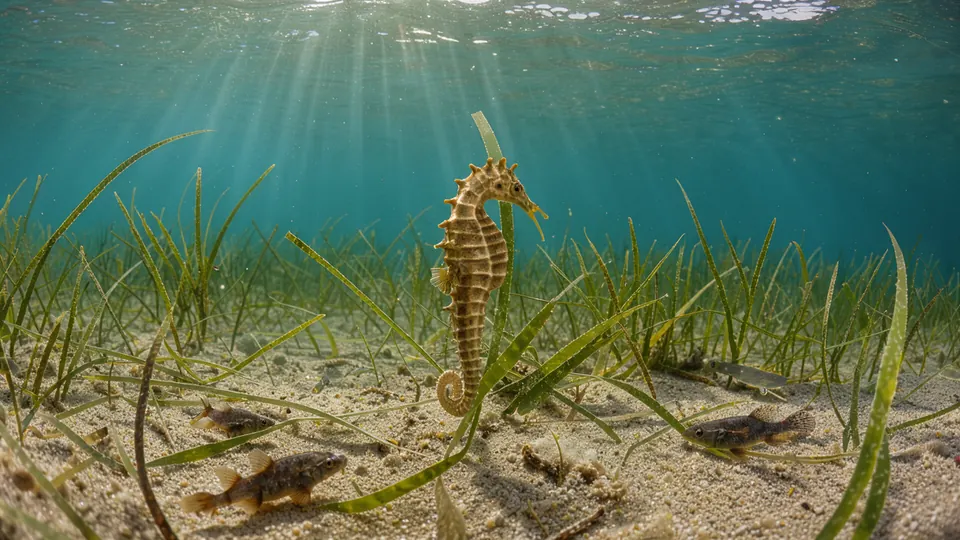
- Sea horses: Yes, seahorses live in the Black Sea! Found around rocky shores and seagrass beds near Nesebar. Rare and protected.
- Crabs: Shore crabs are abundant on rocky coasts. Kids enjoy finding them in tidal pools.
- Mussels: Black Sea mussels grow naturally on rocks and breakwaters. The ones in restaurants are farmed for safety and sustainability.
Environmental Challenges
- Overfishing: Commercial fishing has reduced fish stocks significantly over the past decades. Sustainable fishing practices are gradually being adopted.
- Pollution: Rivers carry agricultural runoff and industrial waste into the sea. The Danube alone drains half of Central Europe through the Black Sea.
- Algal blooms: Nutrient pollution causes periodic algal blooms that reduce oxygen in surface waters and affect marine life.
- Plastic waste: Like all seas, the Black Sea faces growing plastic pollution. Beach cleanups help, but systemic solutions are needed.
- Invasive species: The comb jelly (Mnemiopsis leidyi), accidentally introduced from American waters, devastated the Black Sea ecosystem in the 1980s-90s by consuming zooplankton and fish larvae.
Swimming Safety
- Water quality: Beaches near Nesebar are regularly tested and generally meet EU bathing water standards. Check the blue flag status of your beach.
- Currents: Generally mild, but can form after storms. Always swim where lifeguards are present.
- Temperature: June 20-22C, July 24-25C, August 25-27C, September 24-26C. Comfortable for extended swimming from late June through September.
- Salinity: About 17-18 parts per thousand — roughly half the Mediterranean's salinity. This lower salt content means you float less but the water feels gentler on skin and eyes.
Get local stories & deals
One email a month with the best Black Sea stories and seasonal deals. No spam.