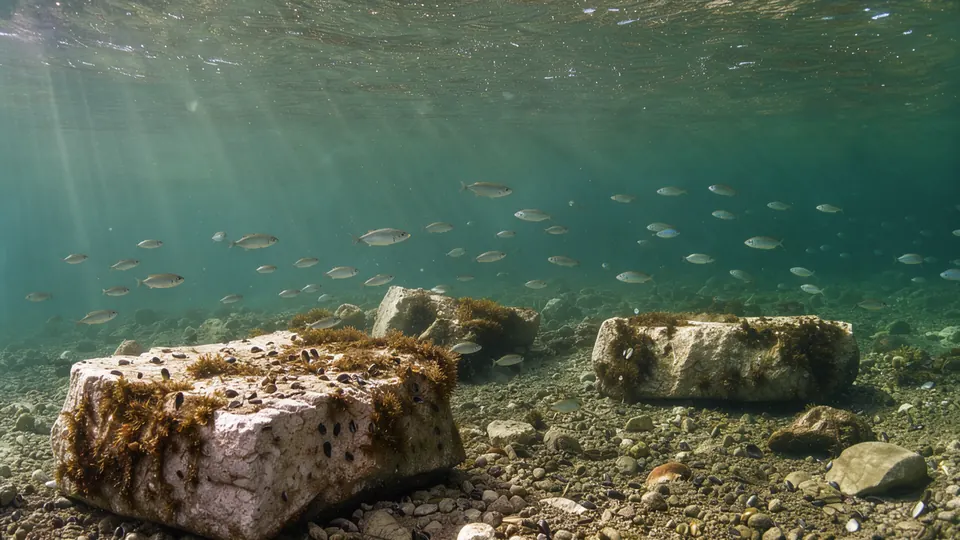
One of the most fascinating aspects of Nessebar's history lies not on its picturesque cobbled streets but beneath the waves that lap against the peninsula. Archaeological surveys conducted over the past six decades have established beyond doubt that a significant portion of ancient Mesembria is now submerged, claimed by the sea over the course of two and a half thousand years through a combination of rising water levels, tectonic subsidence, and coastal erosion. The visible Old Town that delights visitors today is, in effect, only the surviving crown of a much larger settlement.
A City That Slipped Beneath the Sea
The peninsula on which Nessebar sits is connected to the mainland by a narrow, low-lying isthmus barely a few hundred metres wide. In antiquity this neck of land, and the gently shelving shores around the rock, supported streets, houses, harbour quays, and stretches of the defensive wall that have since vanished underwater. Geologists studying the Black Sea coast attribute the change to a slow but relentless rise in the relative sea level — the Black Sea stood several metres lower in the Hellenistic period than it does now — compounded by the gradual sinking of the land itself.
The result is that the modern shoreline cuts straight through what was once the heart of a thriving ancient port. Scientists estimate that the peninsula may have been up to three times its current size in antiquity, meaning that whole quarters of Greek, Roman, and Byzantine Mesembria are preserved on the seabed, protected from the looting and rebuilding that erased so much of the city on land.
The Underwater Expeditions
Systematic underwater archaeology at Nessebar began in earnest in the 1960s, when Bulgarian researchers, sometimes working alongside international teams, began mapping the submerged remains ring the peninsula. These surveys revealed an extraordinary catalogue of structures lying just a few metres below the surface: sections of the fortification walls, the foundations of buildings, paved streets, and the installations of the ancient harbour, including breakwaters and mooring features.
What the Divers Found
Among the most remarkable underwater discoveries are the remains of a large Hellenistic building complex located roughly 100 metres offshore. Its scale and construction suggest a public building or a temple rather than a private dwelling — a monumental presence that once stood proudly on dry land. Divers have also recovered a rich assemblage of smaller finds: numerous ancient stone and lead anchors that document centuries of seafaring, abundant fragments of pottery and amphorae that once carried wine, oil, and grain, and even the hull of a medieval ship resting near the entrance to the harbour, a poignant reminder of the maritime traffic that gave the city its wealth.
Each of these objects is a piece of evidence. The anchors map the approaches that ancient captains used; the amphora sherds trace trade routes reaching across the Mediterranean and the Pontic world; the submerged walls reveal the true ambition of the city's planners.
Why the Sunken City Matters
These underwater ruins provide crucial evidence for understanding just how large and important ancient Mesembria once was. On land, the constant rebuilding of a continuously inhabited town has destroyed or buried much of the earliest archaeology. Beneath the sea, by contrast, structures abandoned to the water have lain comparatively undisturbed, offering archaeologists a rare window onto layers of the city that have disappeared everywhere else. The submerged quarter is, in a real sense, the missing chapter of Nessebar's story.
A Harbour Beneath the Waves
The drowned harbour is perhaps the most evocative part of the underwater city. In antiquity, Mesembria's wealth flowed through its quays, and the installations now lying offshore — moorings, breakwaters, and the worn remains of working waterfronts — preserve the infrastructure of a port that connected the Bulgarian coast to the whole Mediterranean and Pontic world. The scatter of anchors recovered from the seabed marks the very spots where ancient vessels once dropped them, and the pottery that litters the bottom is the discarded packaging of centuries of trade: amphorae that carried wine from the Aegean, oil from distant groves, and grain from the fertile hinterland. To dive here is to swim through a frozen moment of commercial life.
Preserving the Underwater Heritage
The submerged remains pose unusual challenges for protection. Unlike a building on land, an underwater site cannot be fenced or easily guarded, and it is exposed to the slow erosion of currents and storms as well as the risk of looting and the impact of modern coastal activity. Bulgarian heritage authorities treat the underwater zone around the peninsula as a protected archaeological area, and ongoing survey work continues to document the remains and recover artefacts before they are lost. This careful stewardship ensures that the sunken city, though largely invisible, remains part of the protected legacy of Nessebar for which the Old Town is so famous — an extension of the UNESCO-recognised heritage out beneath the waves.
What Visitors Can See Today
The sunken city remains largely the preserve of divers and researchers, but its presence shapes the experience of every visitor. Walking the eastern and southern edges of the peninsula on a calm, clear day, you can often see masonry and worked stone lying just below the waterline, and the line of the ancient walls plunging into the sea. The Archaeological Museum of Nessebar displays anchors, amphorae, and other artefacts recovered from the seabed, giving context to what lies offshore. Local diving operators occasionally offer supervised excursions to view the shallower remains. Standing on the rocks at the edge of the Old Town, it takes only a little imagination to picture the streets and quays that once continued out across what is now open water.
Frequently Asked Questions
How much of ancient Nessebar is underwater?
A substantial portion. Researchers estimate the peninsula may once have been up to three times its present size, with entire quarters — including stretches of wall, streets, buildings, and harbour works — now lying several metres below the surface.
When did the underwater exploration begin?
Systematic underwater archaeological expeditions have been conducted since the 1960s, gradually mapping the submerged remains around the peninsula.
What have divers actually found?
Sections of the city walls, building foundations, paved streets and harbour installations, a large Hellenistic building complex about 100 metres offshore, numerous ancient anchors, quantities of pottery, and the hull of a medieval ship near the harbour entrance.
Why did the city sink?
A combination of rising relative sea levels in the Black Sea and the gradual subsidence of the land caused the sea to advance over the lower-lying parts of the peninsula across roughly two thousand years.
Can tourists see the sunken remains?
Some shallow remains are visible from the shore on calm, clear days, and recovered artefacts are displayed in the Archaeological Museum. Supervised diving excursions are sometimes available for a closer look.
Discover more about the layered past of this remarkable peninsula and plan your own visit by exploring our guide to Nessebar.
Get local stories & deals
One email a month with the best Black Sea stories and seasonal deals. No spam.