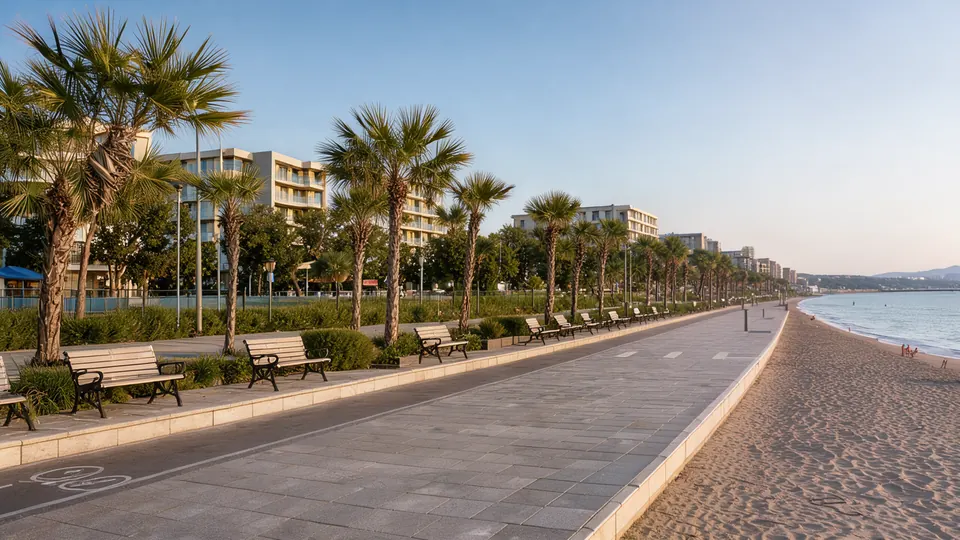
Nesebar has two parts – the Old Town and the New Town – linked by a narrow isthmus (Nesebar Municipality tourist guide). The Old Town on the peninsula is the UNESCO World Heritage site. The New Town on the mainland is the modern part of Nesebar: here you find the town square, the Nesebar-South beach and, under and between the buildings, the ancient necropolis of Mesambria. Part of the New Town even lies within the buffer zone of the World Heritage site.
Town and municipality
Nesebar is the administrative centre of a municipality in Burgas Province. The municipality covers 420.4 sq km and includes 14 settlements: the towns of Nesebar, Obzor and Sveti Vlas and 11 villages, as well as the Sunny Beach resort. According to the municipality, the town of Nesebar has 15,293 inhabitants. The figures are updated every six months; the latest count is from 3 July 2026. The municipal administration is at 10 Edelvais Street.
How the New Town grew
Before tourism developed, according to the Ancient Nessebar Museum, Nesebar was a small town living mainly from fishing and farming – above all vine-growing and flax. The turning point came in the second half of the 20th century. By Council of Ministers Decree No. 243 of 18 July 1956, the town of Nesebar and its coast were declared a "museum, tourist and resort complex of national and international importance" (Cultural Heritage Strategy of Nesebar Municipality 2023–2032). From 1959, after the Sunny Beach resort was built, international tourism developed actively in the town and the surrounding area.
The strategy notes that the main change in Nesebar's skyline is precisely in the New Town, because of its rapid growth and the spread of resort uses after the 1960s. The new construction has irreversibly changed the cultural landscape of the mainland part. The municipal tourist guide lists the modern kindergartens, the town stadium, the Artium centre for culture and education and the new town square "in the heart of the modern town". A seafront promenade links the isthmus of Old Nesebar with Sunny Beach.
The ancient necropolis of Mesambria
The New Town is home to the necropolis – the burial ground of the ancient and medieval town. It lies on the mainland slope facing the sea, directly opposite the isthmus, and according to the document "Values and Attributes of the Cultural Heritage of the Ancient City of Nessebar" (2026) the area was used for burials right up to the Ottoman period.
- Discovery. The necropolis was first located in 1911 by Prof. Katsarov, when a valuable bronze hydria (water jar) of the 4th century BC was found. More systematic research was carried out by Prof. Ivan Galabov in 1948–1952, when several dozen ancient graves were found.
- Lost graves. After 1990, large-scale construction of multi-storey buildings with deep foundations began here and destroyed many graves. Large excavations took place again in 2007–2010.
- How many graves. "Values and Attributes" gives more than 1,000 graves uncovered over an area of about 3 hectares. The report of the joint World Heritage Centre/ICOMOS mission of 2023 gives different figures: more than 1,300 graves over 15,000 sq m by 2010.
- Periods. Four periods have been documented: Classical (5th–4th century BC), Hellenistic (4th–2nd century BC), Late Antiquity and the Middle Ages (12th–14th century). For Late Antiquity the sources differ: "Values and Attributes" gives the 2nd–4th century, the 2023 mission the 4th–7th century.
- Finds. The grave goods include hydriai, gold jewellery, pottery, terracottas, bronze buckles and rings. The 2023 mission mentions six bronze hydriai used as urns for cremated remains, four of them with relief mythological scenes. Finds from the necropolis have been shown at exhibitions in Barcelona (2005), Japan (2008) and the Louvre (2015).
By an order of the Minister of Culture of 20 August 2024, the necropolis was given the status of an archaeological immovable cultural value of national importance. In 2026 the World Heritage Committee approved a modification of the buffer zone of the Ancient City of Nessebar that brings the necropolis area into it. In 2023 the restored windmill on the isthmus hosted the exhibition "The Riches of the Ancient Necropolis of Mesambria", with more than 100 objects from the 5th century BC to the 4th century AD. According to Bulgaria's 2023–2024 state of conservation report to UNESCO, the municipality is exploring ways to display the cist graves (graves built of shaped stone blocks) and to extend the Archaeological Museum.
The third windmill
The Ancient Nessebar Museum writes that, of the many windmills built in Nesebar in the 19th century, three survive: in the middle of the isthmus, on the north shore of the peninsula and at the beginning of the new part of the town. The New Town windmill is in the necropolis area, on Ivan Vazov Street. According to the 2023 mission report, the hotel built there has incorporated the mill into its building, and the windmill has been removed from the list of cultural monuments – this is also shown in the list of the National Institute for Immovable Cultural Heritage (NIICH). For the other two windmills see our article on the windmills of Nesebar.
Beaches and nature
According to the Cultural Heritage Strategy, the largest beaches in the municipality are at Sunny Beach and Nesebar-South (Nesebar-Yug) in the New Town; in 2022 Nesebar-South was among the beaches awarded the Blue Flag. In the southern part of the New Town there is also the yacht harbour of the National Sailing Base. Nesebar lies within the Natura 2000 protected areas "Aheloy – Ravda – Nesebar" and "Emine" (municipal guide), and there are sand dunes along the municipality's coast.
Getting around
- To the Old Town: Han Krum Street links the old part of town with the municipal and national road network. Mini-trains connect the old and new parts and Sunny Beach, on a route set by order of the mayor (Strategy). Boats between Sunny Beach and Nesebar leave from the South Port and the North Port of Nesebar (municipal guide).
- Tourist coaches: according to Bulgaria's state of conservation report for the 2023 and 2024 seasons, their stop for the new part of town was the Windmill car park.
- From further away: Nesebar is 36 km north-east of Burgas. There is no railway station in the town – the nearest is in Burgas. Burgas Airport is 26 km away according to the Strategy and about 30 km according to the municipal guide.
The link with the World Heritage site
The buffer zone of the Ancient City of Nessebar covers the newly gained land in the south-western part of the peninsula, the two-kilometre strip of sea around it and part of the "new town" area on the mainland, where the necropolis is (Vision for the Ancient City of Nessebar, 2026, describing the 2008 boundaries). The modification approved in 2026 added a further part of the necropolis area. For this reason UNESCO keeps a close eye on building here. The 2023 mission notes that development in the necropolis area is completely transforming the landscape around the property and harming the visual link between the peninsula and the mainland, and recommends turning the area into a protected archaeological park. According to the 2026 ICOMOS evaluation, the protection regimes for the necropolis require archaeological surveys before development, limit construction and provide for keeping the visual links between the mainland and the peninsula.
If you have come to Nesebar for the Old Town, start your walk at the isthmus and carry on to the harbours and the churches – for example St John the Baptist and St Spas.
Sources
- Nesebar Municipality, about the municipality (Bulgarian)
- Nesebar Municipality, tourist guide (PDF in Bulgarian)
- Cultural Heritage Strategy of Nesebar Municipality 2023–2032 (PDF in Bulgarian)
- "Values and Attributes of the Cultural Heritage of the Ancient City of Nessebar", 2026 (PDF in Bulgarian, Nesebar Municipality)
- Shared Vision for the Ancient City of Nessebar (2026–2045), draft of 28 January 2026 (PDF in Bulgarian, Nesebar Municipality)
- Annexes to the Shared Vision for the Ancient City of Nessebar (2026–2045), 27 January 2026 (PDF in Bulgarian, Nesebar Municipality)
- Ancient Nessebar Museum, history of the town (Bulgarian)
- Ancient Nessebar Museum, the windmills (English)
- NIICH, list of immovable cultural heritage in the town of Nesebar (XLS, June 2025)
- UNESCO World Heritage Centre, Ancient City of Nessebar
- ICOMOS evaluation of the buffer zone modification, 2026 (PDF)
- Bulgaria's request for a buffer zone modification, 2026 (PDF)
- Report of the joint World Heritage Centre/ICOMOS mission, January 2023 (PDF)
- Bulgaria's state of conservation report, 2023–2024 (PDF)
Checked on 28 October 2026. Transport and beach information changes, so check it before you travel.
Get local stories & deals
One email a month with the best Black Sea stories and seasonal deals. No spam.