The Beaches of Burgas Bay and the Bird Lakes: Flamingos, Pelicans and When to See Them
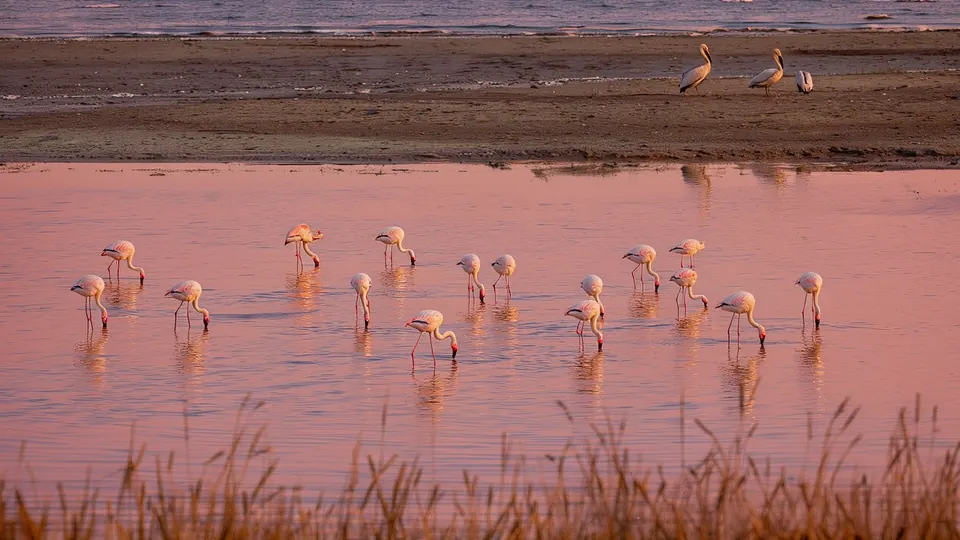
Here is an underrated fact about the road between Nessebar and Burgas: for a few kilometres it runs along a narrow causeway with the sea on one side and a pink-violet salt lake full of flamingos on the other. Most people drive it twice without ever stopping.
Burgas Bay is a rare combination. Within a few kilometres you have sandy beaches and four wetlands that make this one of the most important bird sites in Europe.
Why there are so many birds here
Via Pontica, Europe's second largest bird migration flyway, passes directly over Burgas: the Balkan mountains funnel migrating birds towards the coast and they concentrate over this bay. The result is over 300 recorded species in a small area. More in the Via Pontica article.
The four lakes
| Lake | What it is | What you will see | Access |
|---|---|---|---|
| Atanasovsko | hypersaline lagoon and working saltworks | flamingo, black-winged stilt, avocet, waders | dykes off the Burgas–Sunny Beach road |
| Pomorie | hypersaline lagoon | flamingo, sandwich tern, waterbirds | visitor centre on the southern shore |
| Burgas (Vaya) | Bulgaria's largest natural lake, freshwater | pelicans, herons, ducks | west of Burgas, viewpoints |
| Mandra / Poda | freshwater lake and protected area | pelicans, cormorants, herons, raptors | visitor centre on the Sozopol road |
Atanasovsko Lake
It lies inside Burgas itself, divided into salt pans that turn pink and violet in summer. It is a managed reserve, a Ramsar wetland of international importance and part of Natura 2000.
The birds are not the only draw: open-air pools near the southern end are where people coat themselves in healing black mud, dry in the sun and rinse off. Most dykes are freely accessible, though visitor facilities and organised trails may carry a small fee. The municipality has marked several routes around the lake, which also work well by bicycle.
Pomorie Lake
The smaller and quieter of the two salt lakes. A visitor and conservation centre built by the Green Balkans organisation stands on the southern shore, with a terrace and optics for watching greater flamingo, sandwich tern, avocet and black-winged stilt. It normally opens Tuesday to Sunday, roughly 09:00–18:00 with a lunch break — check ahead, as the schedule changes out of season.
Pomorie is about 20 km from Nessebar and combines easily with the salt lake and mud therapy day trip.
Poda and Mandra Lake
Poda is a protected area south of Burgas on the Sozopol road, with a visitor centre and hides. It is the easiest site for beginners: the birds are close, optics are provided and there is interpretation. Both pelican species that visit Bulgaria — great white and Dalmatian — occur here.
Burgas Lake (Vaya)
The country's largest natural lake, freshwater, west of the city. Harder to watch independently, but it holds the largest autumn flocks.
When to go
- March–May (spring migration): pelicans, storks and raptors returning from Africa.
- June–July: breeding season — fewer species but more behaviour, with colonies and chicks.
- Late August–October (autumn migration): the best window. Tens of thousands of white storks pass over Burgas in flocks, along with pelicans and raptors. A stork "chimney" spiralling over the bay is unforgettable.
- November–February: wintering geese and ducks, with flamingos increasingly staying through the cold months.
An honest word on flamingos: greater flamingo now appears regularly at Atanasovsko and Pomorie lakes, but is never guaranteed on a given day. Chances are best in late summer, autumn and winter. Treat it as a bonus, not an itinerary.
The beaches in the same bay
You do not have to choose between birds and swimming.
- Sarafovo, north of Burgas — sandy, quiet, local, with good fish restaurants.
- Burgas central beach, below the Sea Garden — wide and convenient.
- Pomorie — a long strip of dark, mineral-rich sand and very shallow water.
- Aheloy and Ravda, between Pomorie and Nessebar — calm and family-friendly.
- Nessebar South Beach, closest to the old town — see the beach guide.
A ready-made one-day route
07:30 leave Nessebar — birds are active at dawn and hide in the afternoon.
08:15 stop at Atanasovsko Lake on the way, walk the dyke with binoculars.
10:00 Poda visitor centre, the most concentrated watching of the day.
12:00 lunch in Burgas — see the city guide.
13:30 the Sea Garden and central beach for a swim.
16:00 Pomorie Lake on the way back.
18:00 back in Nessebar.
By car this is a relaxed day. By bus you can manage Atanasovsko and Pomorie — see public transport in the area.
Practical notes
- Binoculars. 8x42 is the all-round choice; without them you will see white dots.
- Muted clothing — no bright white or orange.
- Repellent. Wetlands mean mosquitoes, especially at dusk.
- No drones over the reserves; it is prohibited and enforced.
- Do not enter the salt pans outside the designated mud areas — they are a working industry.
- Sun. The dykes have no shade whatsoever.
See also Black Sea nature facts, the interactive map, the Nessebar guide and available apartments 20–35 minutes from every site listed here.
Frequently asked questions
Is there an entrance fee for the lakes?
Walking most dykes and trails is free. Visitor centres, guided tours and the mud pools may charge a small fee, usually a few euro.
When do the storks pass?
The main wave runs from late August to late September. On a good day tens of thousands cross over Burgas within a few hours. Children cope well with this if the stop is short and they hold the binoculars; Poda is the best site for them.
Get local stories & deals
One email a month with the best Black Sea stories and seasonal deals. No spam.