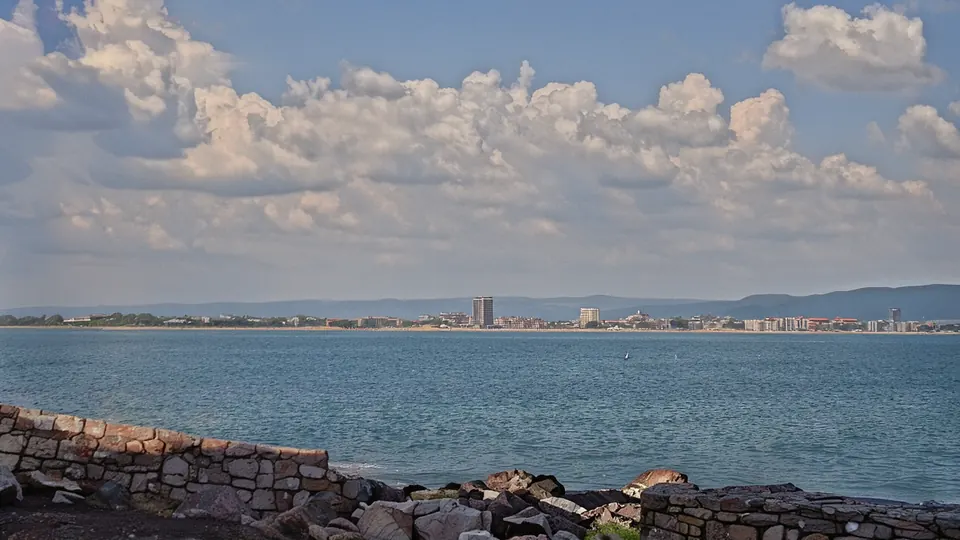
The relationship between ancient Nessebar and the modern resort of Sunny Beach is one of the most striking contrasts in European tourism. On one side, a rocky peninsula with churches from the fifth century and UNESCO World Heritage status since 1983. On the other, the largest seaside resort on the Bulgarian Black Sea coast, built from nothing in two decades. A few kilometres of sand and one bus line separate them, and they complement each other perfectly.
How Sunny Beach came to exist
The resort did not grow the way fishing villages grow. It was designed. Planning began in 1957 under a team led by architect Nikola Nikolov, construction was launched by a Council of Ministers decree of 30 June 1958, and the first hotels opened on 1 September 1958. Through the 1960s it expanded massively.
The site was empty: roughly 8 km of sand between Nessebar and Sveti Vlas, with no settlement on it. Today it carries hundreds of hotels, restaurants and entertainment venues, raised on dunes within one generation. That story is told in our piece on Nessebar's socialist past, and the resort as it is now in the Sunny Beach resort guide.
The Old Town: 850 metres that did not change
Old Nessebar sits on a rocky peninsula about 850 m long and up to about 350 m wide, joined to the mainland by a narrow man-made isthmus. That is the whole town, crossable on foot in fifteen minutes if you did not stop — and you will stop, for the churches, the Revival-period houses and the walls above the water.
The contrast is literally geographic: stand on the isthmus, look one way and hotel silhouettes run to Sveti Vlas; look the other and you see stone-slab roofs and a fourteenth-century dome. For a route around it, see our guide to Nessebar Old Town.
Side by side: what each place is for
| Old Nessebar | Sunny Beach | |
|---|---|---|
| Atmosphere | Open-air museum, still a lived-in town | Resort strip, running around the clock |
| Noise | Quiet after 22:00 | Music until morning in the centre |
| Beach | Small, rocky shore | Long, wide sand, shallow entry |
| Prices | Highest at waterfront tables | Very cheap to expensive |
| Families | Fine over 5 or 6; cobbles beat prams | Shallow water, water parks |
| Nightlife | Effectively none | Why many people come |
| Parking | Difficult; cars restricted | Easier, tight in peak season |
| Suits | Culture, photography, quiet evenings | Beach days, water sports, groups |
Neither is the better place. If nightlife is what you came for, our Sunny Beach nightlife guide beats any church.
Getting from one to the other
- Bus line 1 links Old Nessebar with Sunny Beach, roughly every 10 to 15 minutes in summer, from about 05:45 until around midnight, ticket about 1 €.
- Walking the beach is the best way to feel the distance, but the strip is long: take shoes, water and a hat.
- By boat. Boats and water taxis run along this coast in season, but routes and timetables change yearly, so ask at the harbour.
- By car is the worst idea in July and August: parking near the Old Town is limited and expensive. See our guide to public transport around Nesebar.
A day that uses both
Start on the beach at Sunny Beach while the sand is still walkable. Take the bus back for lunch in Old Nessebar after 13:00, choosing a street one block inland rather than the first table by the water, then spend the afternoon on the churches, the walls and the museum.
Then stay for sunset. Few visitors notice what happens next: around 19:00 to 20:00 the day-trippers pull out, the buses fill up back towards the resort, and Old Nessebar goes quiet. Streets impassable at 15:00 are yours at 21:00. From there you choose — dinner on the peninsula while Sunny Beach is only just waking up, or the bus back and a long night on the strip.
Where to base yourself
It depends on which bothers you more, noise or distance. Old Nessebar and the adjoining new town suit people who want quiet and walking, at the cost of smaller beaches and little choice after 23:00. Sunny Beach suits beach holidays, families with small children and anyone who wants everything in one place, at the cost of noise. Sveti Vlas is quieter, at the far end of the same strip. See our accommodation guide for Nesebar for a breakdown by area; apartments with kitchens are in the property catalogue, where you contact the host directly.
Whichever you choose, the two keep each other alive. Sunny Beach hands its visitors one of Europe's most important archaeological sites, and Nessebar gains a flow of people who would not otherwise seek out a small historical town — a flow that pays for the museums and the restoration.
Practical information
- Distance. A few kilometres along the coast; bus line 1 covers it in minutes, ticket about 1 €, paid to the driver or at the stop.
- When. July and August are peak: warmest water, biggest crowds, highest prices. June and September give warm sea and half the crowds.
- How long. One day covers both; two days let you see the Old Town without rushing.
- Tip. Avoid Old Nessebar between 11:00 and 15:00 in mid-August; early morning and after 18:00 it is a different town.
Frequently asked questions
Which is better for a family with small children?
For children under five or six, Sunny Beach is usually more practical: wide sand, a shallow entry, water parks and everything within reach. Old Nessebar is beautiful, but cobblestones and steep lanes do not work with prams. A good compromise is to stay away from the central resort strip, where music runs until morning.
Is it worth staying in Old Nessebar itself?
If you want atmosphere and quiet evenings, yes. The peninsula empties after sunset, and that is the moment worth being there for. Be aware that cars are restricted, parking is difficult, shops are few and the beaches are modest.
Get local stories & deals
One email a month with the best Black Sea stories and seasonal deals. No spam.