The Black Sea for Beginner Swimmers and Families with Small Children
The Black Sea has a reputation as an easy sea — no tides, no sharks, warm water in August. Some of that is true. The rest is misleading, and every summer it costs lives, usually of people who were certain they swam well enough.
This article covers what to know before you let a child into the water, or go in yourself as a mediocre swimmer.
Why it is not the Mediterranean
There is one physical difference nobody explains to visitors: salinity here is roughly half that of the oceans and the Mediterranean — about 17–18 parts per thousand against around 35.
The consequence is simple and important: the water supports you less. Someone who floats effortlessly in the Aegean or Red Sea sinks more easily here and tires faster. This catches out many confident Mediterranean swimmers.
There are also no meaningful tides, which breeds false confidence: the danger here comes from wind and waves, not the lunar calendar.
The flags
Every guarded beach flies a flag stating the current sea condition.
| Flag | Meaning | What you do |
|---|---|---|
| Green | Calm and safe | Swim normally, still watch children |
| Yellow | Rougher water, caution needed | Children knee-deep with an adult; weak swimmers stay out |
| Red | Swimming prohibited | Stay out, however well you swim |
| Two red | Heightened danger | Do not enter even the shallows |
The flag changes through the day. The same beach can be green at 09:00 and red at 16:00 because the afternoon breeze raises a swell. Check the flag every time you come back to the beach, not once in the morning.
A red flag is not over-caution. It goes up precisely because currents form beneath apparently ordinary waves.
Rip currents: the commonest cause of incidents
When waves push water towards the shore, that water has to return. It does so through narrow channels, usually where the bottom is deeper. That is a rip current — a narrow band of water moving away from the beach.
How to spot one
- a section where waves are not breaking while they break to the left and right
- a strip of darker or murkier water, often with foam and suspended sand
- foam or weed visibly moving away from shore
What to do if caught
- Do not swim against it. It is stronger than any swimmer, and exhaustion — not the current itself — is what kills.
- Swim parallel to the shore until you are out of the channel; it is typically 10–30 metres wide.
- Then angle back towards the beach.
- If you cannot, roll onto your back, stay afloat, raise an arm and shout.
A rip does not pull you under. It carries you out. Stay calm and the odds are strongly in your favour.
Which beaches suit small children
Look for three things: a gentle slope, lifeguards, and shelter from the wind.
- Nessebar South Beach — a fairly gradual entry with facilities close by.
- Sunny Beach central strip — long and shallow-shelving, but the busiest.
- The Ravda coves towards Nessebar — shallow, rocky in places, so bring water shoes.
- Obzor — a long beach with a gentle gradient and far calmer than the southern resorts.
- Pomorie — narrower, but sheltered along part of its length.
The full comparison is in our Nessebar beach guide.
The best time of day
Mornings before 11:00. The sea is calmest before the daytime breeze, the sun is not yet dangerous, and the beach is not packed. Between 12:00 and 16:00, sun exposure alone is a risk for a small child.
Rules that actually work
- Only swim on a guarded beach with children or as a weak swimmer. Lifeguards are typically on duty during daytime hours in the summer season; outside those hours the beach is formally unguarded even if it looks busy.
- One adult watches the water and does nothing else. No phone, no book, no conversation with your back to the sea. Announce out loud when the watch changes.
- Arm's length. For under-fives, take that literally.
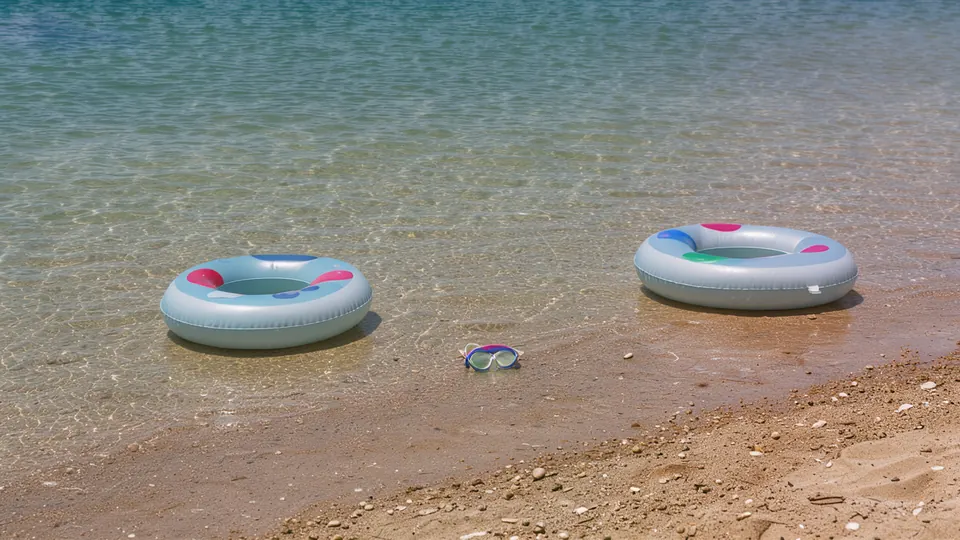
- Inflatable toys are not safety equipment. Rings, mats and armbands flip and blow away in seconds. A properly sized life vest is a different matter.
- Never use inflatables in an offshore wind. That is the classic scenario in which a child ends up 200 metres out.
- Do not swim after drinking, and do not assume you can stand — the bottom shifts after storms.
More precautions in our health and safety tips and the family checklist.
Jellyfish, sun and water temperature
Black Sea jellyfish are generally harmless. The common moon jellyfish barely stings; larger barrel jellyfish can cause mild irritation. Rinse contact with sea water rather than fresh, and do not rub. More on this in the sea at Nessebar: temperature and jellyfish.
Water temperature runs about 20–22 °C in June, 24–26 °C in July and August, and a still-pleasant 22–24 °C in September. For small children, June is often too cool for long spells in the water.
In an emergency
The European emergency number is 112, answered in Bulgarian and English. If you see someone in trouble, call a lifeguard rather than going in yourself — a large share of drownings are would-be rescuers. More numbers in our emergency contacts list.
Frequently asked questions
At what age can a child swim unsupervised?
Not until they can confidently swim at least 50 metres and roll onto their back. Even then, a yellow flag means an adult goes in too.
Is the Black Sea more dangerous than the Mediterranean?
Not inherently, but it punishes overconfidence. Lower salinity means less buoyancy, and wind raises a swell quickly. On the other hand, no tides and no dangerous marine animals make it predictable in other ways.
What should I pack for a child?
A correctly sized life vest instead of armbands, water shoes for stones and shells, a hat, high-factor sunscreen and a UV shirt for hours by the water. Full list in Black Sea travel with toddlers.
Get local stories & deals
One email a month with the best Black Sea stories and seasonal deals. No spam.