Sunrise and Sunset Around Nesebar: Exact Spots, Times and Directions
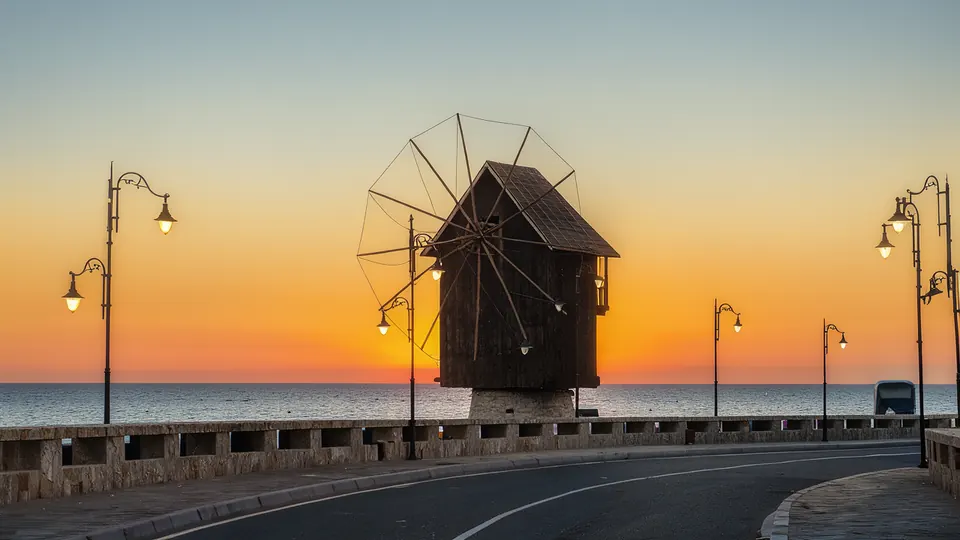
The Nesebar peninsula has a rare advantage for photographers: it juts into the sea on an almost east–west axis. That means you can shoot sunrise over open water and sunset over land in the same place, walking five minutes from one end of the Old Town to the other.
This guide is about the practicalities — where exactly to stand, at what time, and where the sun will actually appear through the year.
Times and directions across the year
Figures are approximate for Nesebar and shift by a few minutes year to year. Azimuth is the compass direction of the sun, measured clockwise from north.
| Date | Sunrise | Azimuth | Sunset | Azimuth |
|---|---|---|---|---|
| 21 June | around 05:35 | 57° (north-east) | around 20:50 | 303° (north-west) |
| 1 May / 12 August | around 06:00 | 70° (east-north-east) | around 20:05 | 290° (west-north-west) |
| 22 September | around 06:55 | 90° (due east) | around 19:10 | 270° (due west) |
| 21 December | around 07:35 | 123° (east-south-east) | around 16:40 | 237° (west-south-west) |
The practical conclusion: in summer the sun rises to the left of the peninsula, in winter to the right of it. The same composition therefore looks completely different in June and December, and the winter sunset falls over the water of the bay toward Pomorie while the summer one drops behind the mountains.
Golden hour lasts roughly 30–40 minutes, and blue hour adds another 30 minutes before sunrise and after sunset. That is when the floodlights on the churches come on while the sky still holds colour — the best Nesebar photograph is usually not the sunset itself.
Sunrise spots
The eastern tip of the peninsula
The obvious choice, and the best one. Follow the seafront path along the fortress wall to the very end of the peninsula, past the ruins of St John Aliturgetos. The sun comes straight out of the sea with rocks and 5th-century masonry in the foreground.
- Arrive 40 minutes before sunrise.
- Wear shoes with grip; the stones are wet with dew and spray.
- Do not climb the fortress wall itself. It is part of a UNESCO site and unstable in places.
Nesebar North Beach
A long shallow strand with calm water at dawn, ideal for reflections. In June the sun clears the sea to your left while the peninsula stays as a silhouette on the right. Details on the beach itself in our beach guide.
The southern end of Sunny Beach
From here Old Nesebar is a distant silhouette to the south and the sun rises over open water — the cleanest backlit postcard of the peninsula. Bonus: at 05:30 the beach is empty even in August.
Sveti Vlas and the marina breakwaters
A pure sea horizon with yachts for foreground interest, five minutes on foot from most rentals in Sveti Vlas.
Cape Emine, for the determined
About 25 km north, beyond Elenite. The lighthouse stands on a high headland and sunrise from there is the most dramatic on this coast. You need a car, and the last stretch is rough road. Leave Nesebar around ninety minutes before sunrise.
Sunset spots
The western wall and the windmill
The wooden windmill on the causeway is the town's emblem, and the setting sun passes directly behind it through the warmer half of the year. Stand on the path by the harbour and shoot into the light — the windmill silhouette and the Old Town roofs are a reliable composition. Landmarks nearby are covered on our interactive map.
South Beach and the new town promenade
These face west-south-west, which makes them the place for autumn and winter sunsets over water, with Pomorie a thin line on the horizon. In June the sun sets off to the side, behind land.
The harbour at blue hour
The still water of the harbour basin mirrors the lit churches and the masts. The most underrated shot in Nesebar. Pair it with an evening walk through the lit lanes.
Pomorie salt lake
About 20 km away. The shallow pans mirror the sky, and flamingos and waders supply the foreground. The best sunset-over-water location in the whole area — see our Pomorie day trip.
Technique and small tricks
- Use a long lens for the sun itself. 100–200 mm makes the disc large and compresses the layers. Wide angle is for the sky after sunset, not for the sun.
- Tripod and remote for blue hour; exposures run 1–10 seconds.
- Graduated filter or bracketing so the sky does not blow out.
- Check the wind, not just the cloud. After a strong northerly the air is crystalline; in heavy August haze the horizon turns milky.
- May and June bring sea fog at dawn — unpredictable, but when it works it is the finest light of the year.
- A sun-path app saves disappointment: the direction shifts by nearly 60 degrees between June and December.
More locations and compositions are in our photography guide.
Frequently asked questions
Can I enter the Old Town before sunrise?
Yes. The peninsula has no gates and is accessible around the clock, and the lanes are lit. The car park at the entrance is paid but effectively empty at 05:00.
Which month is best for sunrises?
September and October. The sun rises at a civilised hour, the sea is still warm, low mist is common and the air is clearer than in summer.
Is there anywhere for coffee at 05:30?
Almost nowhere — Old Town venues open around 08:00. Bring a flask, or stay on the peninsula so you are five minutes from the spot; see the property catalogue.
Get local stories & deals
One email a month with the best Black Sea stories and seasonal deals. No spam.