Monasteries and Churches Beyond Nesebar: Where to Go After the Peninsula
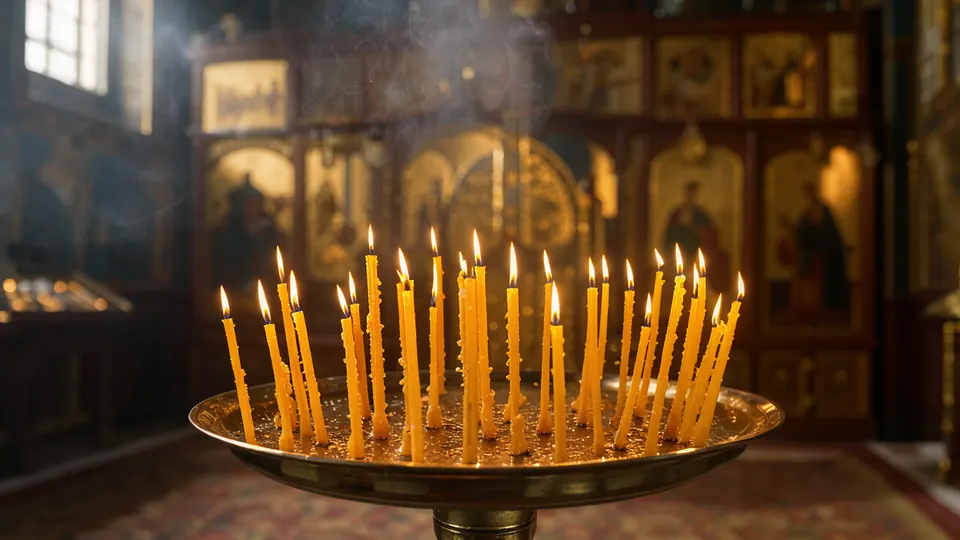
Nesebar packs more than forty churches onto a single peninsula, and for most visitors that is enough. But after two days of Byzantine brick and blind arcading, the surrounding region offers something genuinely different: living monasteries with monks and a holy spring, half-buried Revival-era churches, and a monastery carved into a vertical limestone cliff.
Here are the ones worth the detour, how to reach them, and what to expect.
Pomorie Monastery of St George the Victorious
The most significant spiritual site near Nesebar, roughly 20 km away at the Burgas-side entrance to Pomorie.
The legend is local and well told. In the 17th century a Turkish bey named Selim fell gravely ill. One of his labourers dreamed of a healing spring in the courtyard and of St George appearing on a white horse; digging at the spot revealed a marble relief of the saint and a spring beneath it. Selim recovered, converted with his whole family, and built a chapel — the seed of today's monastery. The present church dates from 1856 and holds valuable 18th and 19th-century icons.
Practical notes:
- The monastery is active and receives pilgrims. Entry is normally free; donations are expected.
- The holy spring and the miraculous icon are why people come. Around St George's Day in May it is extremely busy.
- Monks live here — the residential wing is not a tourist area.
- It pairs perfectly with a Pomorie day trip and the salt pans.
The old churches of Pomorie
Behind the harbour stands the Church of the Transfiguration, the oldest building in Pomorie. Like many Revival-era churches on this coast it is half sunk into the ground: Ottoman rules forbade a church from rising above a mosque, so builders dug downward instead. Inside it is low, dim and far more affecting than the exterior suggests.
Burgas: three city churches
Burgas is not a pilgrimage town, but it has three interesting churches within a twenty-minute walk of each other:
- The Cathedral of Sts Cyril and Methodius in the centre — the largest, with an imposing interior and 20th-century murals.
- The Church of the Dormition, the oldest Orthodox church in the city, modest and authentic.
- The Armenian Church of Surp Hach, a small and rarely visited reminder of the city's Armenian community.
All three fit into one afternoon; see the Burgas guide.
Sozopol and the relics of St John the Baptist
About 70 km south, Sozopol is the other ancient fortress town on this coast. In 2010 archaeologists on the island of St Ivan, opposite the town, found a marble reliquary whose human remains researchers described as the closest match to the profile of the biblical John the Baptist among all relics attributed to him in Europe. The relics are kept in the Church of Sts Cyril and Methodius in Sozopol, and each summer they are carried in procession to the harbour and out to the island.
Old Sozopol also has several half-buried Revival churches, including St Mary's with its remarkable carved wooden iconostasis.
Aladzha Monastery: the furthest and the most striking
The rock monastery of Aladzha lies about 100 km north, inside Golden Sands Nature Park near Varna. Carved into a sheer limestone face, it was inhabited by hermit monks in the 13th and 14th centuries. Cells, a church and an ossuary occupy two levels linked by stairs.
| Detail | Value |
|---|---|
| Adult entry | around €2.56 |
| Child entry | around €1.53 |
| Summer hours (May–October) | daily, 09:00–17:00 |
| Winter hours | Tuesday–Saturday, 09:00–17:00 |
| Distance from Nesebar | around 100 km, roughly 1 h 40 min by car |
This is a full day and only makes sense combined with Varna or Balchik — see our day trips guide.
What about the nearby villages?
Honestly, there are no hidden monasteries here. Ravda, Aheloy and Tankovo have modest, mostly modern village churches — pleasant to pass, not worth a journey. Sveti Vlas takes its name from a medieval monastery dedicated to St Blaise, of which almost nothing visible survives; more on the town in the Sveti Vlas guide.
If you want atmosphere rather than mileage, stay on the peninsula: our interactive map covers everything within one walk.
Etiquette in a working church
The difference between a museum and a living monastery matters:
- Cover shoulders and knees. Women often prefer a skirt or a scarf tied at the waist; baskets of scarves are usually available at the entrance.
- Never enter in beachwear, even if you have come straight from the sand.
- Candles for the living go on the upper stand, for the departed on the lower. Ask if unsure.
- Photographing the altar area or the monks without permission is not acceptable, and many churches ban flash because of the frescoes.
When to go
- St George's Day, 6 May — the great feast at the Pomorie monastery; expect crowds and a genuine celebration.
- Assumption, 15 August — the Day of Nesebar and a feast in many coastal churches.
- Nikulden, 6 December — the fishermen's feast, the most authentic winter event on this coast.
- Easter — the midnight liturgy in any of these churches is a powerful experience.
Frequently asked questions
Can I reach the Pomorie monastery without a car?
Yes. The Nesebar–Pomorie bus stops nearby, and from central Pomorie it is a 20–30 minute walk or a few euro by taxi. Check schedules in our transport guide.
What is the best one-day church itinerary?
Pomorie: the monastery, the Church of the Transfiguration and the salt pans. That is around 40 km in total and fits comfortably between 10:00 and 17:00.
Get local stories & deals
One email a month with the best Black Sea stories and seasonal deals. No spam.