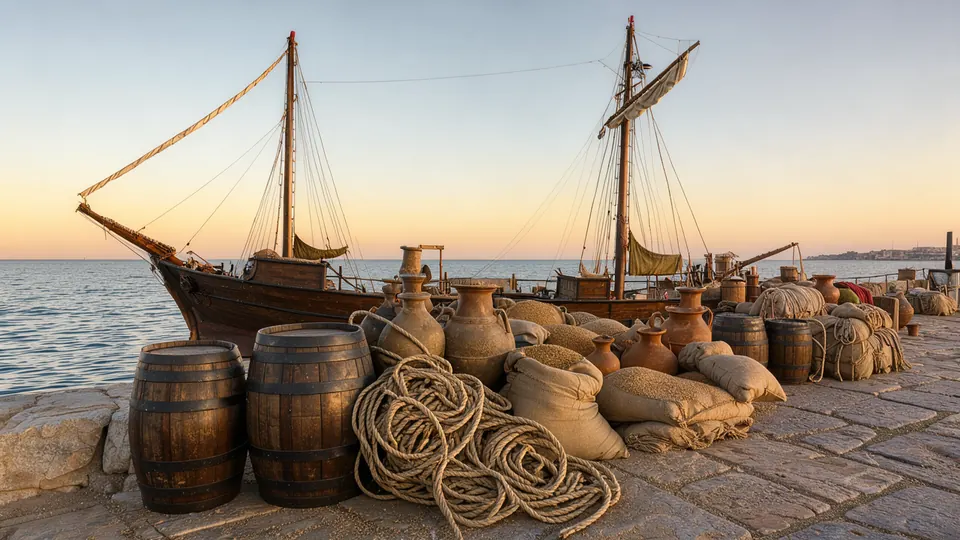
During the late medieval period, the Italian maritime republics of Venice and Genoa extended their commercial networks across the Black Sea, weaving the ports of the Bulgarian coast into a vast trading system that linked the Mediterranean to the Pontic world. Nessebar — the ancient Mesembria, still a busy harbour beneath its crown of churches — played a significant role in this Mediterranean-Pontic exchange. Neither republic ever directly controlled the city, yet the long shadow of Italian commerce left lasting marks on its architecture, its economy, and its culture, making the late medieval centuries one of the more cosmopolitan chapters in the town's history.
The Italian Republics on the Black Sea
By the 13th and 14th centuries, Venice and Genoa had become the dominant maritime powers of the eastern Mediterranean. Following the upheavals surrounding the Fourth Crusade and the eventual restoration of the Byzantine Empire, both republics secured trading privileges that gave them access to the Black Sea, whose grain, fish, timber, slaves, and luxury goods were immensely valuable to the markets of Italy. They established colonies and trading stations at the great Pontic hubs — Genoa most famously at Kaffa in the Crimea, Venice at Tana and elsewhere — and from these bases their merchants ranged the entire sea.
Genoese Merchants at Nessebar
Genoese merchants established trading posts along the Bulgarian Black Sea coast in the 13th and 14th centuries, integrating local ports into their commercial web. In Nessebar, they maintained commercial facilities and warehouses near the harbour area, where goods could be stored, taxed, and transshipped. The influence of Italian architectural styles can be detected in certain details of buildings from this period, particularly in the use of decorative stonework and in the rational organisation of commercial spaces — the practical fingerprints of a trading culture that valued sturdy storehouses and well-ordered quaysides.
The Venetian Rivalry
Venetian traders, the great rivals of the Genoese, also maintained a presence in the region, and the two republics waged a long competition — sometimes commercial, sometimes openly violent — for control of the Black Sea trade routes. This rivalry brought both prosperity and conflict to Nessebar. Prosperity flowed from the constant traffic of ships and the demand for the city's services and goods; conflict came when the wars between the republics, or between them and rival powers, spilled into the waters off the Bulgarian coast. For a port city, the presence of competing foreign merchants was a double-edged blessing: it filled the warehouses but could also draw the town into struggles far larger than itself.
A Strategic Stopover
Nessebar's enduring importance in this period rested on geography. The city's strategic position on its easily defended peninsula, with a sheltered harbour, made it a valuable stopover point for merchants travelling the long sea roads between Constantinople, the Crimean ports such as Kaffa, and the trading centres at the mouth of the Danube. Ships beating up or down the western coast of the Black Sea needed safe anchorages, fresh water, and markets, and Nessebar offered all three. This made the town a natural node in the network, even though it remained under Bulgarian and then Ottoman authority rather than Italian control.
Goods Along the Sea Roads
The cargoes that passed through Nessebar in these centuries reveal the character of the trade. From the Pontic hinterland came grain, salted and dried fish, hides, wax, and timber — bulk commodities that the cities of Italy needed in great quantity. In return flowed the finished goods and luxuries of the western Mediterranean: fine cloth, glassware, metalwork, and the spices and silks that had themselves travelled from the East before being redistributed by Italian merchants. Nessebar's warehouses would have held a cross-section of this exchange, and the customs dues levied on goods moving through the port were a source of revenue for whoever held the city. The Black Sea, in short, was not a backwater but a vital artery of late medieval commerce, and Nessebar sat squarely upon it.
The Twilight of Italian Trade
The age of Venetian and Genoese dominance in the Black Sea did not last forever. The rise of the Ottoman Empire in the fourteenth and fifteenth centuries gradually closed the sea to the Italian republics, and the Ottoman conquest of Constantinople in 1453 — followed soon after by the fall of the Pontic colonies — brought the era of free Italian trade to an end. Nessebar, conquered by the Ottomans around the same time, passed into a new political and commercial world. Yet the imprint of the Italian centuries was not erased. The habits of trade, the organisation of the port, and the cosmopolitan outlook of a town long accustomed to foreign merchants survived the change of rulers, woven permanently into the fabric of the place.
The Lasting Legacy
The legacy of this period can be traced in the city's urban layout, with its clearly defined commercial district near the harbour — a zoning of trade and storage that reflects the demands of international commerce. It can be read, too, in the sophistication of its late medieval architecture, which absorbed the cosmopolitan influences that flowed through this important trading hub. Nessebar in these centuries was not an isolated Bulgarian town but a meeting point where Greek, Bulgarian, Byzantine, and Italian worlds overlapped, and that layering is part of what gives the Old Town its distinctive character.
What Visitors Can See Today
The visitor today can still sense this mercantile past. The Old Town's layout preserves the logic of a working port, with its lanes funnelling down toward the harbour where the warehouses once stood. The decorative stonework of surviving medieval and later buildings rewards a close eye, and the harbour itself — still busy with fishing boats and pleasure craft — occupies the same sheltered waters that drew Genoese and Venetian galleys centuries ago. The Archaeological and Ethnographic Museums help set this trading history in context, allowing visitors to imagine the Italian merchants who once bargained on these very quaysides.
Frequently Asked Questions
Did Venice or Genoa ever rule Nessebar?
No. Neither republic directly controlled the city, but their commercial influence left lasting marks on its architecture, commerce, and culture.
When were the Genoese active at Nessebar?
In the 13th and 14th centuries, when Genoese merchants established trading posts along the Bulgarian Black Sea coast and maintained facilities near the harbour.
Why was Nessebar important to Italian merchants?
Its strategic peninsula and sheltered harbour made it a valuable stopover between Constantinople, the Crimean ports, and the Danube trading centres.
How can the Italian influence be seen today?
In the city's urban layout, with its commercial district near the harbour, in decorative stonework, and in the cosmopolitan sophistication of its medieval architecture.
What did the Venetian-Genoese rivalry mean for the city?
Their competition for control of Black Sea trade routes brought both prosperity, through trade, and conflict, when their wars reached the region.
Step into this crossroads of medieval Mediterranean trade by exploring our guide to Nessebar.
Get local stories & deals
One email a month with the best Black Sea stories and seasonal deals. No spam.