The Uncrowned King of Mesembria: A Deep Dive into the Church of Christ Pantocrator
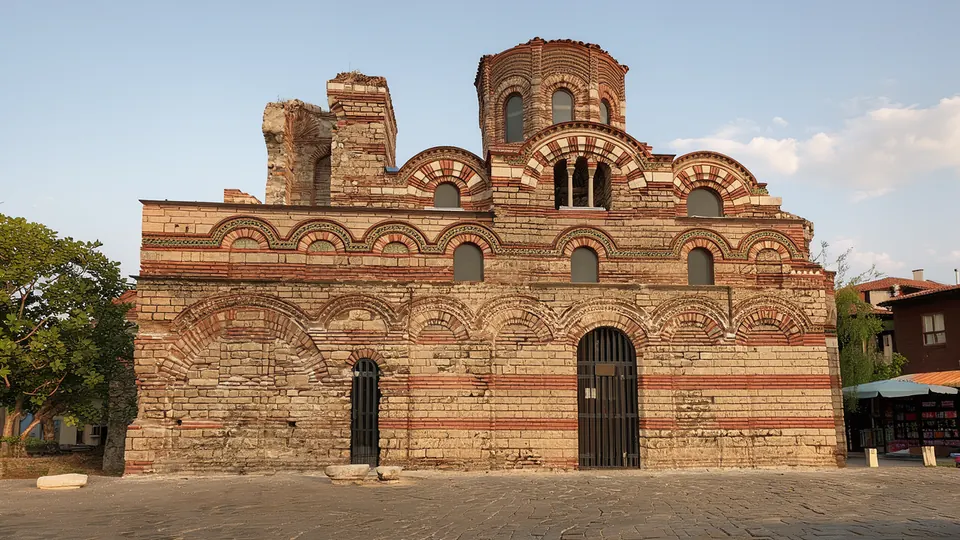
As you pass through the main gates of Old Nessebar, leaving the modern isthmus behind, one of the first and most dazzling sights to greet you is not a fortress wall or a seaside villa, but a symphony in brick and stone: the Church of Christ Pantocrator. Poised majestically in a small square, its intricate facade seems to capture centuries of history, faith, and artistic genius. While the Church of St. Stephen has its famous frescoes and St. Sophia its monumental ruins, the Pantocrator church stands as arguably the most brilliant surviving example of the late medieval architectural style that made Mesembria (Nessebar's medieval name) famous throughout the Byzantine world. Constructed during the cultural zenith of the Second Bulgarian Empire in the 13th and 14th centuries, this building is more than just a place of worship; it is a declaration of wealth, sophistication, and a deep understanding of Orthodox Christian cosmology, all encoded in its vibrant exterior.
Today, it no longer functions as a church, having been transformed into an intimate art gallery. Yet, to simply walk past it on the way to the harbour is to miss one of the peninsula’s greatest stories. This article delves into the history, architecture, and symbolism of this uncrowned king of Nessebar's churches, offering a guide to understanding its enduring legacy for your visit in September 2026.
A Symphony in Brick and Stone: The "Picturesque" Style Perfected
The Church of Christ Pantocrator is the quintessential example of Nessebar's "picturesque" style, a term used by art historians to describe the highly decorative and dynamic architectural trend that flourished along the Black Sea coast during the 13th and 14th centuries. This style blended Byzantine traditions with local innovations, creating facades that were meant to be admired as works of art in themselves. The church is believed to have been built during the reign of Bulgarian Tsar Ivan Alexander (1331–1371), a period of remarkable cultural renaissance, though some elements suggest an earlier, late 13th-century origin.
The architectural plan is a cruciform dome design, with a cross-shaped core topped by a central dome (cupola), and a narthex (vestibule) to the west which was once surmounted by a slender, rectangular bell tower. While the dome and bell tower have been partially lost to time and earthquakes, the surviving structure is a masterclass in decorative masonry. The builders employed a technique known as opus mixtum, creating alternating horizontal bands of meticulously carved white limestone blocks and fiery red bricks. This alone gives the walls a striped, rhythmic quality, but the true artistry lies in the details layered upon this foundation.
The facades are alive with ornamentation. Look closely at the eastern apse and you will see three elegant, multi-faceted sides adorned with rows of blind arches. The walls are embellished with a breathtaking variety of brickwork patterns: chequerboards, sun motifs (including swastikas, an ancient solar symbol used across many cultures long before its 20th-century appropriation), and complex geometric friezes. The most distinctive feature, however, is the use of glazed ceramic inlays. Hundreds of small, circular and four-leafed pottery discs, coloured a brilliant turquoise, deep green, and rich brown, are embedded into the mortar like jewels. These shimmering details catch the sunlight, making the entire building appear vibrant and alive—a clear statement of the patron's wealth and status, as these ceramics were costly luxury items.
The "Ruler of All": Symbolism and Sacred Function
The church's dedication to "Christ Pantocrator" (Христос Пантократор in Church Slavonic) is deeply significant. The term, meaning "Christ, Ruler of All" or "Christ Almighty," refers to a specific iconographic depiction of Jesus that dominated the central domes of Orthodox churches. From this highest point in the church, the image of a stern yet merciful Christ would gaze down upon the faithful, his presence encompassing the entire sacred space. While the interior frescoes of the Nessebar church have been almost entirely lost, we can be certain that a magnificent Pantocrator fresco once adorned its dome, surrounded by depictions of angels, prophets, and apostles, creating a visual representation of the Heavenly Kingdom on Earth.
What remains of the interior is sparse, revealing the raw brick and stone of its construction. This emptiness invites contemplation on the church’s original purpose. Given its relatively modest size but incredibly lavish exterior, it is unlikely to have been a public cathedral for the entire city. Instead, scholars believe it was either the main church (katholikon) of a monastery or a private family chapel built by a wealthy aristocrat or high-ranking official from Mesembria. Such a patron would have spared no expense on the exterior to showcase their piety and social standing, commissioning a building that was both a sanctuary for prayer and a public monument to their influence.
Centuries of Silence and a New Awakening
The fall of Nessebar to the Ottoman Turks in 1453 marked a turning point for its Christian monuments. While some churches were converted into mosques, many, like the Pantocrator, were simply abandoned and fell into ruin. Stripped of its religious function, the church stood silent for centuries, a beautiful but neglected relic of a bygone golden age. It endured the slow decay of time, the harsh seaside climate, and the tremors of several earthquakes that damaged its upper structures, including the dome and bell tower. The remarkable skill of its medieval builders is the only reason its walls stand so proudly today.
In the 20th century, with the revival of interest in Bulgaria's national heritage, the Church of Christ Pantocrator became the subject of extensive conservation and restoration work. These efforts stabilized the structure and cleaned its facade, preserving it for future generations. Its exceptional artistic and historical value was a key factor in Nessebar's inscription as a UNESCO World Heritage Site in 1983.
No longer consecrated for religious services, the building was given a new lease on life as an art gallery. This adaptive reuse is a common and sensitive solution for many of Nessebar's historic churches. Today, its ancient interior provides a unique and atmospheric backdrop for exhibitions of works by local Bulgarian artists, creating a fascinating dialogue between the medieval and the modern.
How to Experience the Pantocrator in September 2026
Visiting the Church of Christ Pantocrator is an essential part of any trip to Nessebar. Its location, just a short walk from the main entrance to the Old Town, makes it unmissable. To truly appreciate it, however, requires more than a quick photograph.
First, take your time to walk around the entire exterior. Each facade offers a different combination of decorative elements. The morning and late afternoon sun—the famed "golden hour"—is particularly magical, as the low-angled light highlights the texture of the stone and brick and makes the ceramic inlays glitter. Don't be afraid to get close to the walls to see the intricate details of the masonry and the colourful pottery.
Once you have admired the exterior, step inside. In September 2026, you will likely find an exhibition of paintings or graphics. While there is usually a small entrance fee for the gallery, it is a wonderful opportunity to experience the interior space and support local artists. The contrast between the ancient, hallowed architecture and the contemporary art it houses is a powerful experience.
To place the church in context, consider a themed walking tour. Start at the Pantocrator, then visit the nearby Church of St. John the Baptist, a much more austere and powerful example of 11th-century architecture. Afterwards, head to Nessebar's Archaeological Museum, where you can see artifacts recovered from the peninsula's many churches, including fragments of frescoes and architectural details that help you imagine how these buildings once looked in their full glory.
Get local stories & deals
One email a month with the best Black Sea stories and seasonal deals. No spam.