The Church of the Holy Archangels Michael and Gabriel
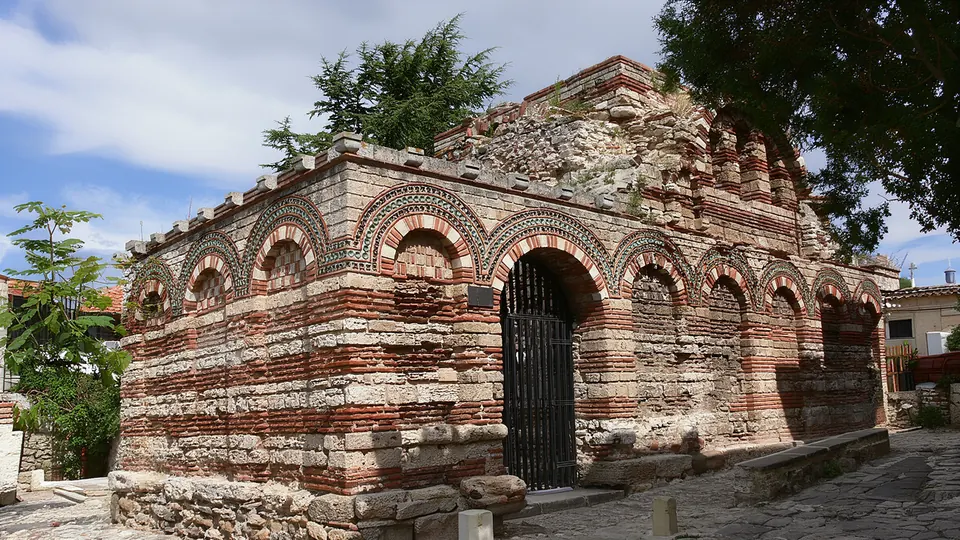
The Church of the Holy Archangels Michael and Gabriel, built in the 13th century, is one of the most architecturally distinctive medieval churches in Nessebar. This compact yet richly decorated building exemplifies the mature phase of the Nessebar architectural school, a tradition that produced some of the finest small-scale ecclesiastical buildings in the medieval Balkans. Set among the more than forty churches that once crowded the small peninsula, it remains one of the clearest illustrations of why Nessebar earned its place on the UNESCO World Heritage List.
A Masterpiece of the Nessebar Architectural School
The church features a cross-in-square plan crowned by a single dome on a tall octagonal drum. This plan, in which a central dome rests on four supporting points framed by a square of vaulted bays, was the standard solution of mature Byzantine and Bulgarian church architecture, and Nessebar's builders refined it to a high art. The proportions are deliberately vertical, drawing the eye upward toward the drum and dome, while a narthex at the western end once prepared worshippers for entry into the sanctuary.
What makes the building particularly remarkable is the extraordinary variety of decorative techniques employed on its exterior walls. Blind arcading, ceramic discs, and intricate brickwork patterns combine to create a facade of exceptional visual richness. The walls are built in the so-called mixed technique characteristic of the period, alternating bands of pale stone with courses of red brick, a method that was both structurally sound and visually striking.
The Decorated Facades
The eastern facade is especially noteworthy, with its elaborate arrangement of arched niches, trefoil patterns, and colorful ceramic inserts arranged in geometric compositions. The green, brown, and white glazed ceramic ornaments stand out against the warm red of the brickwork, creating a tapestry-like effect. These glazed ceramic discs and rosettes were fired in local or regional workshops and set into the masonry as the walls rose, turning the church into something close to a polychrome jewel box when seen in full sunlight.
The layering of blind arches, recessed niches, and rows of small ceramic medallions shows how Nessebar's craftsmen thought of a church facade as a surface to be composed rather than merely built. The same decorative vocabulary appears, in different combinations, across Nessebar's other late-medieval churches, but the Holy Archangels church concentrates it with unusual intensity.
A Church Among Many
To understand this building it helps to remember that Nessebar was, for much of its history, a town crowded with churches. The peninsula is small, yet at its height it supported a remarkable number of sanctuaries, serving a population that was deeply Orthodox and a town that took pride in its many parishes and monastic foundations. The Holy Archangels church was therefore not an isolated monument but one voice in a chorus of medieval architecture, each building competing in beauty and devotion. This density of churches, unusual for so small a place, is precisely what later earned the Old Town its protected status, and the Holy Archangels church is one of its most eloquent witnesses.
The dedication of the church to the Archangels Michael and Gabriel is itself telling. As the chief of the heavenly host and the messenger of the Annunciation, these two archangels were among the most venerated figures in Orthodox devotion, and a church raised in their honor would have held an important place in the spiritual life of the medieval town.
Survival and Conservation
Although the church suffered earthquake damage over the centuries, significant portions of its decorative exterior survive intact. Nessebar sits in a seismically active region, and several of the town's churches lost their domes, vaults, or upper walls to tremors over the centuries. The Holy Archangels church, while reduced from its original form, retained enough of its richly worked walls to remain one of the most photographed monuments in the Old Town.
Conservation efforts in recent decades have stabilized the structure and preserved its remarkable ornamentation for future generations. The church stands as evidence of the extraordinary artistic ambition of medieval Nessebar's builders, and its protection forms part of the wider effort to safeguard the peninsula's medieval heritage.
What Visitors Can See Today
Today the church is preserved as an architectural monument rather than an active place of worship. Visitors approaching from the main street of the Old Town can walk around the building to study the decorated facades up close, where the bands of stone and brick, the blind arcading, and the surviving glazed ceramic ornaments are all visible at eye level. The eastern end, with its trio of apses, repays slow examination, as this is where the densest decoration survives.
Because the monument sits in the open within the historic core, there is generally no separate entrance fee to view the exterior, and it can be combined easily with a walk past Nessebar's other landmark churches, several of which stand within a few minutes on foot. Photographers find the warm brick and ceramic glow especially rewarding in the soft light of early morning or late afternoon.
A close look rewards the patient visitor. Tracing the alternating courses of stone and brick reveals the discipline of the original masons, while the surviving ceramic discs — where their glaze still catches the light — hint at how dazzling the whole facade must once have appeared. Set against the backdrop of the sea and the surrounding old houses, the church offers a vivid lesson in how medieval Nessebar fused engineering, faith, and decorative artistry into a single small building.
Frequently Asked Questions
When was the Church of the Holy Archangels Michael and Gabriel built?
The church dates from the 13th century and belongs to the mature phase of the Nessebar architectural school of medieval church building.
What architectural style does the church represent?
It follows a cross-in-square plan with a single dome on a tall octagonal drum, decorated in the mixed stone-and-brick technique with blind arcading and glazed ceramic ornaments typical of late-medieval Nessebar.
Why is the eastern facade so important?
The eastern facade preserves the densest surviving decoration, including arched niches, trefoil patterns, and green, brown, and white glazed ceramic inserts set against red brickwork, making it one of the finest decorated facades in the Old Town.
Can you go inside the church?
The building is preserved primarily as an architectural monument, and its main appeal lies in the richly decorated exterior, which visitors can study freely while walking through the historic core.
Is the church part of Nessebar's UNESCO heritage?
Yes. It is one of the medieval churches that contribute to the value of Nessebar's Old Town, inscribed on the UNESCO World Heritage List for its remarkable concentration of historic monuments.
Discover this and the other medieval churches of the Old Town when you plan your stay in Nessebar.
Get local stories & deals
One email a month with the best Black Sea stories and seasonal deals. No spam.