Night Skies and Long Exposures: Photographing Nesebar After Dark
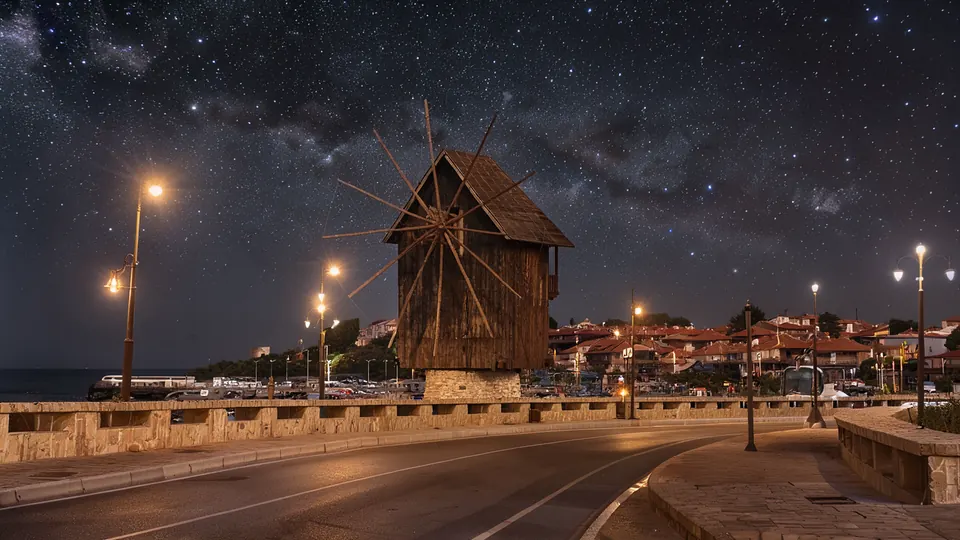
Photographing Nesebar After Dark
The daytime photograph of Nesebar has been taken several million times. The peninsula at night has not, mostly because people go to dinner instead, and it is the better picture.
Why the peninsula works at night
Three things line up here that rarely line up together.
The shape. A narrow neck of land with water on both sides means you can photograph the town as a silhouette from either side, and the lit stone stands against dark water rather than against other buildings.
The reflections. Two harbours, both sheltered, means still water close to the subject. Still water doubles everything.
The scale. It is small enough to walk end to end in twenty minutes, so you can work several compositions in one evening instead of driving between them.
The hours worth using
Blue hour is the one, and most people miss it by half an hour. The twenty to forty minutes after sunset, when the sky still holds colour but the town lights are on, is when the exposure balances — the sky and the stone are within range of each other. Once it is fully dark the lights blow out and the sky goes black and empty.
Get set up before sunset. Blue hour does not wait.
Full dark is for the sky rather than the town: stars over the sea, the Milky Way in summer if you can get away from the lights.
Pre-dawn is the quietest the Old Town ever is, and in summer it is the only time the lanes are empty. Sunrise over the sea from the eastern side of the peninsula is the shot nobody else is up for.
Where to stand
The isthmus, looking back at the town. The classic composition, with the windmill in the foreground and the peninsula behind it. Works at blue hour and it is the safest, flattest ground.
Either harbour. The north and south harbours give you boats, reflections and lit buildings in one frame. The water is calmest at first light and at dusk.
The mainland shore looking across. The whole silhouette against the sky. Longer lens, more compression, and you keep the entire peninsula in one shape.
From a boat. The best angle of all and much harder at night — a boat is never a stable platform. If you try it, raise the ISO and accept noise rather than trying to hold a long exposure.
The practical part
A tripod is not optional for blue hour and after. Anything handheld at those light levels is either blurred or noisy.
Use the two-second timer if you have no remote release. Pressing the shutter shakes the camera more than people think.
Watch the ground. The Old Town's stone paving is uneven, worn shiny in places and slippery when damp, and you will be walking on it in the dark carrying a tripod while looking at a screen. This is the single most likely thing to go wrong.
Bring a small torch and use it pointed down. The lanes are lit unevenly.
Batteries drain in the cold, and the coast is colder at night than the day suggests, particularly outside high summer.
For stars
Nesebar itself has too much light for serious astrophotography — it is a lit town on a small peninsula. For the Milky Way you want to get away from the strip: inland, or north towards the wilder coast past Sveti Vlas where the development thins out.
The season matters: the galactic core is visible in the summer months and gone by late autumn. Moonless nights only, and check the moon phase before planning an evening around it.
Drones
Do not assume. Nesebar's Old Town is a UNESCO World Heritage site, Burgas airport is a short distance down the coast, and the interaction of heritage restrictions with airspace rules is not something a photography guide can clear you for. We have a separate article on this, and its conclusion is to ask the civil aviation authority and the municipality before you travel — not after you have packed the drone.
The short version
Be in position before sunset, use the twenty minutes after it, bring a tripod, and photograph from the isthmus or the harbours. Watch your footing more carefully than your histogram. And if you want stars, drive away from the lights — the town is the subject at dusk and the obstacle at midnight.
Get local stories & deals
One email a month with the best Black Sea stories and seasonal deals. No spam.