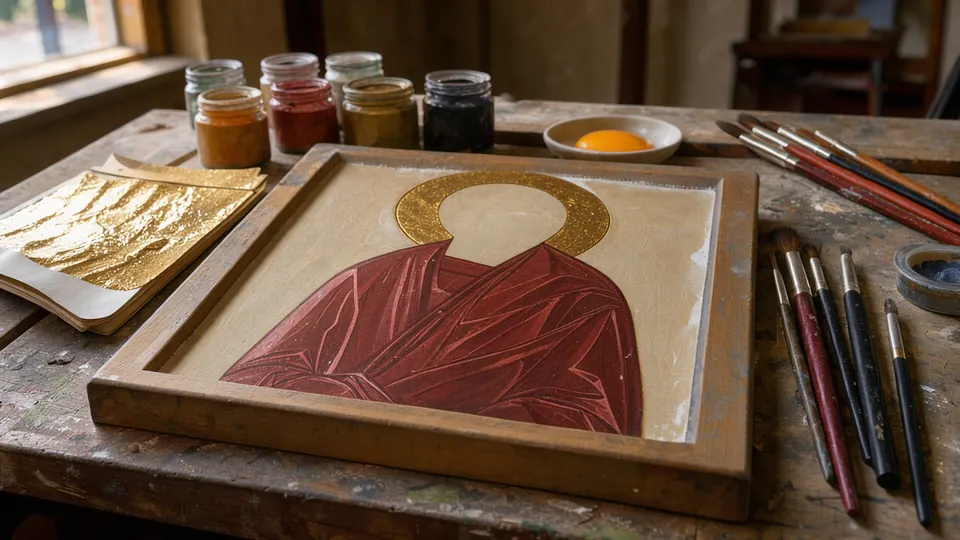
Nessebar has a distinguished tradition of icon painting that spans several centuries. The numerous churches on the peninsula required a constant supply of icons, leading to the development of a local school of icon painting with distinctive characteristics. With more than forty churches once active on the small peninsula, Nessebar was for centuries one of the most intensely devotional towns on the Black Sea coast, and the demand for sacred images shaped a continuous artistic tradition that left its mark across the town's sanctuaries and survives today in its museums and churches.
Byzantine Beginnings
The earliest surviving icons from Nessebar date from the 13th century and show strong Byzantine influence. These works, painted in tempera on wooden panels with gold leaf backgrounds, follow the strict iconographic canons of the Orthodox tradition while displaying a refinement of execution that reflects the city's wealth and cultural sophistication. As a flourishing Byzantine and then medieval Bulgarian town, Nessebar could support painters of high skill, and the gold-ground icons of this period embody the spiritual seriousness and aristocratic taste of their age.
The Craft of the Icon
The techniques behind these icons were demanding and tradition-bound. Painters worked in egg tempera — pigments bound with egg yolk — applied in fine layers over a prepared wooden panel, with backgrounds and haloes covered in gleaming gold leaf. The iconographic canons dictated how each saint, scene, and gesture should be rendered, so that an icon was not an individual invention but a faithful continuation of sacred models. Within these limits, the best Nessebar painters achieved a clarity and elegance of line that set their work apart.
An icon was never regarded as mere decoration. In Orthodox belief it served as a window between the worshipper and the holy figure it depicted, an object of veneration central to both church liturgy and private devotion. This is why the demand was so constant: every church needed its festal icons, its iconostasis panels, and its images of patron saints, and worn or damaged icons had to be replaced. A town as densely churched as Nessebar therefore offered steady work to skilled painters across many generations.
The Revival and a New Warmth
During the National Revival period (18th-19th centuries), Nessebar's icon painters developed a more naturalistic style that incorporated folk art elements. These later icons often feature brighter colors, more detailed landscapes, and a warmth of expression that distinguishes them from earlier, more formal works. As the rigid Byzantine formulas softened, faces became gentler and more human, settings grew richer in everyday detail, and the bright palette of folk decoration found its way into sacred art. This shift mirrored the wider cultural awakening of the Bulgarian National Revival, when religious art drew closer to the life and taste of ordinary believers.
A Local School with Its Own Character
Out of this long history emerged a recognizably local tradition. Because the peninsula's many churches needed icons generation after generation, Nessebar sustained its own community of painters whose work, while rooted in the broader Orthodox and Bulgarian schools, carried distinctive local traits. The continuity from the formal Byzantine icons of the 13th century to the warmer Revival-period works gives Nessebar an unusually complete record of how Bulgarian religious painting evolved over time.
Where the Tradition Lives On
Today, visitors can see examples of Nessebar icon painting in several of the Old Town's churches, particularly in the Church of St. Stephen with its remarkable 16th-century iconostasis. St. Stephen's, often considered one of the most beautiful of all Nessebar's churches, preserves a richly carved and painted iconostasis along with extensive mural decoration, offering one of the finest surviving ensembles of religious art in the town. The Archaeological Museum also houses an important collection of icons spanning the full range of the Nessebar painting tradition, from its Byzantine beginnings to its Revival-period flowering.
What Visitors Can See Today
To explore Nessebar's icon-painting heritage, visitors can combine a tour of the Old Town's churches with a visit to the Archaeological Museum. The Church of St. Stephen, preserved as a monument, displays its celebrated iconostasis and murals, and a modest entrance fee of around five to six leva typically applies to enter the better-preserved church-monuments. The Archaeological Museum, near the entrance to the Old Town, gathers icons from across the centuries under one roof for a similarly modest fee, with reduced rates often available for students. As with the town's other sites, it is wise to confirm current hours and prices before visiting, especially outside the summer season.
Seen together, the icons in the museum and the painted interiors of the churches allow visitors to trace the full arc of a tradition — from the gold-ground formality of the Middle Ages to the colorful warmth of the Revival — within the compact space of the historic peninsula.
This concentration is part of what makes Nessebar so rewarding for anyone interested in religious art. Elsewhere, icons of different periods are often scattered across distant collections; here, the long evolution of a single local tradition can be followed within a short walk. Pausing before an early gold-ground panel and then before a brighter Revival-period work, a visitor can read in the painting itself the gradual shift from austere, otherworldly formality toward a warmer, more human vision of the sacred — a change that mirrors the wider story of Bulgarian art and faith.
Frequently Asked Questions
How old is Nessebar's icon-painting tradition?
It spans several centuries; the earliest surviving icons from Nessebar date from the 13th century, and the tradition continued through the National Revival of the 18th and 19th centuries.
What did the earliest Nessebar icons look like?
They show strong Byzantine influence, painted in tempera on wooden panels with gold leaf backgrounds, following the strict iconographic canons of the Orthodox tradition.
How did icon painting change during the National Revival?
Revival-period painters adopted a more naturalistic style with folk art elements, brighter colors, more detailed landscapes, and a warmer, more human expression than the earlier, formal works.
Where can I see Nessebar icons today?
Examples survive in several Old Town churches, especially the Church of St. Stephen with its remarkable 16th-century iconostasis, while the Archaeological Museum holds an important collection spanning the full tradition.
Is there an entrance fee to see the icons?
The church-monuments and the Archaeological Museum typically charge a modest entrance fee of around five to six leva, often with reduced rates for students; confirm current prices and hours before visiting.
Trace centuries of sacred art through the churches and museums when you plan a visit to Nessebar.
Get local stories & deals
One email a month with the best Black Sea stories and seasonal deals. No spam.