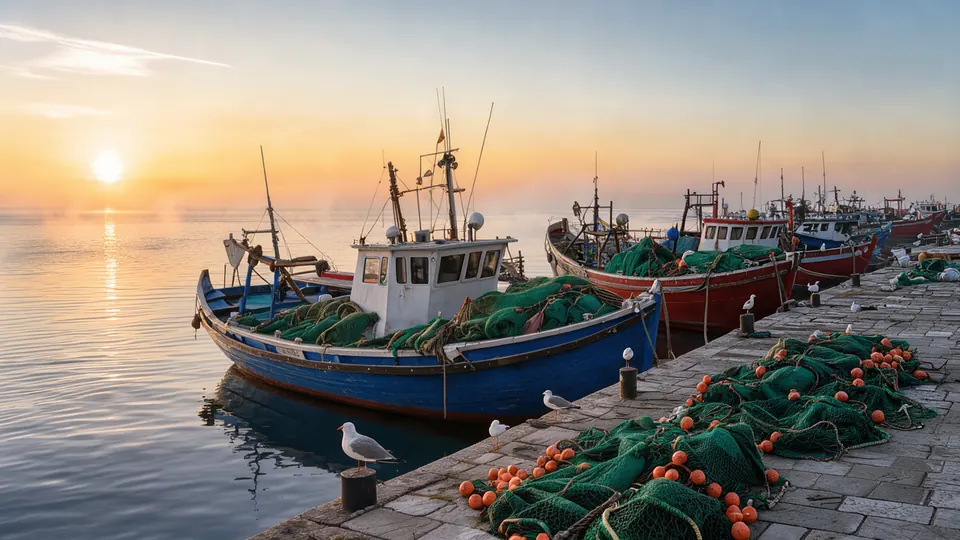
For thousands of years, fishing has been central to life in Nessebar. Long before the town became a UNESCO-listed museum-city and a magnet for summer holidaymakers, it was first and foremost a working harbour — a place where families measured the seasons not by tourist arrivals but by the runs of fish through the Black Sea. The waters around the peninsula are rich in Black Sea species including turbot, bluefish, horse mackerel, sprat, and anchovy, providing a livelihood for generations of Nessebar fishermen.
A Harbour as Old as the City Itself
The small harbour on the south side of the peninsula has served as a fishing port since antiquity. When Greek colonists from Megara founded Mesembria here around the 6th century BC, they chose the rocky tongue of land precisely because it offered shelter from the wind and easy access to abundant fishing grounds. Ancient amphorae recovered from the seabed nearby once carried salted fish and fish sauce — the garum prized across the classical Mediterranean — proving that the local catch was being preserved and traded more than two thousand years ago.
Even today, colourful fishing boats bob alongside the ancient harbour walls, and local fishermen can be seen mending their nets in the early morning light, much as their ancestors did centuries ago. The best time to witness this is between roughly 6 and 8 in the morning, when the boats return with the night's catch and the dock briefly becomes a market, a workshop, and a meeting place all at once.
Reading the Black Sea Calendar
The fishing year in Nessebar follows the rhythm of the species. Spring and early summer bring shoals of horse mackerel (safrid) and bonito; autumn is the season of bluefish (lefer), a prized and powerful fighter that draws both commercial and sport fishermen; and the cold months from November to February belong to anchovy (hamsia) and sprat (tsatsa), the tiny silver fish that, fried whole and crisp, are a defining taste of the Bulgarian coast. Turbot (kalkan), the largest and most valuable of the local catch, is governed by a strict closed season each spring to protect spawning stocks.
Traditional Methods That Still Survive
Traditional fishing methods in Nessebar include net fishing using large seine nets deployed from boats, line fishing for larger species, and the use of fish traps called "daliani" — a technique unique to the Black Sea coast. A dalian is a large fixed trap of nets anchored close to shore, into which fish are guided as they follow the coastline; it is essentially a permanent maze in the water, emptied by hand every day or two. These traditional methods coexist today with modern fishing practices, GPS, and refrigerated holds, but the older techniques have never entirely disappeared.
Net mending, knot-tying, and the seasonal reading of wind and current are skills still passed down from father to son in a handful of Nessebar families. Watching a fisherman repair a torn seine with a wooden needle is to watch a craft that has changed remarkably little in centuries.
The Fish Market and the Taste of the Town
The fish market near the harbour is a beloved institution in Nessebar, where locals and tourists alike can buy fresh catches of the day. Prices are seasonal and depend on the catch, but small fish such as sprat and anchovy are typically very affordable, while turbot and bluefish command a premium. Buying directly from the boats early in the morning is the surest way to find the freshest fish at the fairest price.
Many of the Old Town's restaurants serve traditional fish dishes prepared according to recipes passed down through generations, including the famous Nessebar fish soup (ribena chorba). This rich, sour soup — made from several kinds of small fish, root vegetables, and a final lift of vinegar or lemon — is the dish most associated with the town's culinary heritage. Other classics worth seeking out include grilled bluefish, fried sprat served with a wedge of lemon, and mussels (midi) prepared with white wine or breaded and fried.
Eating Fish Like a Local
To eat well, follow the rhythm of the catch rather than the tourist menu. The simplest, most honest fish meal on the coast is a plate of small fried fish — sprat or sand smelt — with a slice of lemon, a green salad, and a glass of cold white wine or rakia; it is cheap, abundant, and unmistakably local. Larger grilled fish such as bluefish or sea bass are sold by weight, so it is normal to choose your fish at the counter and have it weighed before it is cooked. Asking the waiter what came in that day is the best question you can put to any harbour-side restaurant in Nessebar, and the answer tells you far more than the printed menu.
Why the Fishing Heritage Still Matters
Tourism has transformed Nessebar, but the fishing tradition remains the thread that connects the modern resort to the ancient city beneath it. The harbour is still working, the recipes are still cooked, and the boats still go out. For visitors, this living heritage is part of what makes a stay here feel authentic rather than purely commercial: you can eat fish that was in the sea that morning, in a town that has been catching it for twenty-six centuries.
FAQ
What fish can you eat in Nessebar?
The most typical local species are turbot (kalkan), bluefish (lefer), horse mackerel (safrid), sprat (tsatsa), and anchovy (hamsia). Mussels are also widely served. What is freshest depends on the season.
When is the best time to see the fishing boats?
Early morning, roughly between 6 and 8 a.m., when the boats return to the south harbour with the night's catch and unload by the ancient harbour walls.
What is Nessebar fish soup?
Ribena chorba is the town's traditional fish soup — a rich, slightly sour broth made from several small fish and vegetables, finished with vinegar or lemon. It is the signature dish of the local fishing kitchen.
What are "daliani"?
Daliani are large fixed net-traps anchored near the shore, a traditional Black Sea fishing technique that guides migrating fish into an enclosure to be collected by hand.
Can I buy fresh fish to cook myself?
Yes. The fish market near the harbour sells the daily catch, and buying directly from the boats in the morning gives you the freshest fish at the best prices — ideal if you are staying in an apartment with a kitchen.
To plan a stay where the harbour, the fish market, and the Old Town are on your doorstep, see our Nessebar destination guide and browse apartments and homes to rent.
Get local stories & deals
One email a month with the best Black Sea stories and seasonal deals. No spam.