Nessebar Travel Guide: What to See, Where to Eat and When to Visit
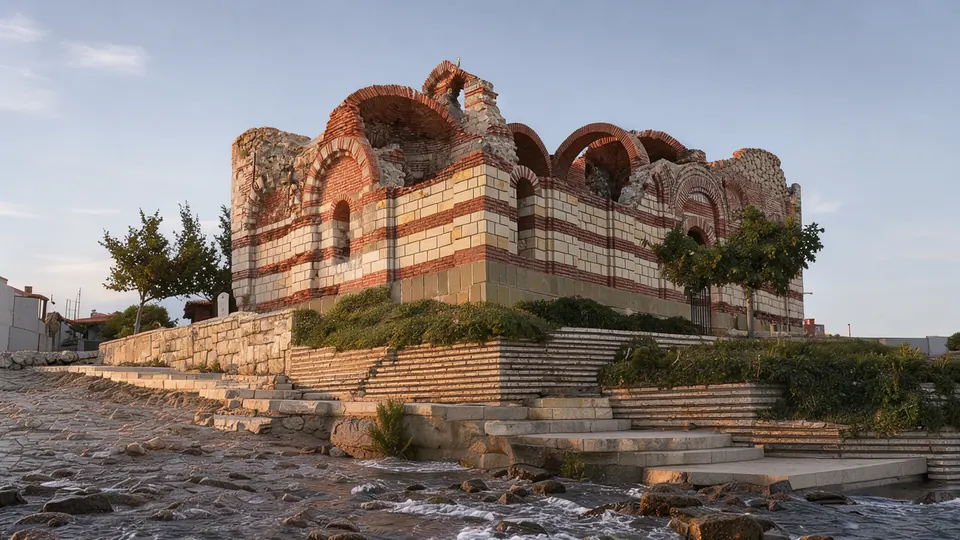
Nessebar is one of the oldest continuously inhabited towns in Europe — settled by Thracians in the second millennium BC, colonised by Greeks who called it Mesembria, fortified by Romans and rebuilt by Byzantines whose churches still stand on the peninsula today. UNESCO added it to the World Heritage list in 1983, and unlike many heritage sites, Nessebar is not a museum piece. People live here. Fishermen mend nets in the harbour. Grandmothers hang laundry between 1,500-year-old walls. It functions as both a working Bulgarian town and one of the Black Sea coast's most concentrated collections of medieval architecture — all packed onto a 850-metre-long rocky peninsula connected to the mainland by a single narrow isthmus.
The Old Town: What to Actually See (and What to Skip)
The Churches
Nessebar once held over 40 churches on its small peninsula — a density that tells you something about the town's historical wealth and strategic importance. Today, roughly a dozen survive in various states. The ones worth your time:
Church of Christ Pantocrator (13th-14th century) sits on the main square and is the most photographed building in town. The exterior brickwork — alternating red and white bands with ceramic rosettes embedded in the facade — is genuinely remarkable and unique to this region. It operates as an art gallery now. Entry is 3 € (about €3).
Church of St John the Baptist (10th-11th century) is the oldest intact church on the peninsula. Plain stone exterior, dim interior, fragments of 14th-century frescoes on the walls. Less visited than Pantocrator, which is part of its appeal.
The Church of St Sophia (the Old Metropolitanate) is a roofless 5th-century basilica near the harbour. You can walk through the nave and look up at open sky through arches that once supported a timber roof. Free to enter, best visited early morning when the tour groups are still at breakfast.
Skip the Archaeological Museum unless you have a specific interest in Greek pottery and anchor stones. The collection is small and the labelling is poor.
The Streets
The real pleasure of old Nessebar is walking without a plan. The residential streets south of the main drag — away from the souvenir shops — are where you find the timber-framed Revival houses that gave the town its UNESCO status. These 18th-19th century houses have stone ground floors and cantilevered wooden upper storeys, built to maximise living space over narrow medieval plots. Ul. Mena and ul. Neptun are particularly well preserved.
Allow two to three hours for the old town. Come before 10:00 or after 17:00 to avoid the cruise ship and Sunny Beach day-tripper crowds that pack the main street between those hours.
The Beaches: South Beach vs North Beach
Nessebar has two main beaches, and they serve different purposes.
South Beach (Южен плаж)
This is the one you want. A 1.5 km arc of fine sand running south from the isthmus toward Ravda, with a gentle gradient that keeps the water shallow for 30-40 metres — good for children and nervous swimmers. Lifeguards are on duty from June to September. The western end has free zones where you can lay your own towel; the eastern end is organised with sunbed and umbrella rentals (typically 8-10 € per set).
Several apartment complexes sit directly on South Beach — Crystal Beach, South Bay and Aphrodite are the closest. First-line properties here command a premium, but the convenience of walking 50 metres from your apartment to the water in flip-flops is worth it if beach time is the priority.
North Beach
A small sandy cove on the peninsula's north side, between the old town walls and the fishing harbour. It is maybe 100 metres long. The water is rougher here because it faces north and catches the prevailing wind, but that also means it is rarely crowded. There are no sunbed rentals or beach bars — just sand and sea. Good for a morning swim if you are staying in the old town.
Where to Eat: A Local's Short List
The old town main street is lined with restaurants competing for tourist attention with identical menus, plastic-coated photo boards and staff who stand outside trying to wave you in. Walk past all of them. Here is where to eat instead:
Kapitanska Sreshta (Captain's Meeting), at the tip of the peninsula near the harbour, serves the best fish in town. Order the tsigansko garne (a clay pot of mixed grilled fish) or whatever the catch of the day is. Sit on the terrace for harbour views. Expect to pay 18-25 € (€18-25) per person with wine.
Neptun on ul. Mena is a small family place with no sea view but reliable Bulgarian home cooking — stuffed peppers, shopska salad, grilled kebapche. The portions are large and the bill is modest: 10-15 € per person.
For breakfast, the bakeries on the main street sell banitsa (filo pastry filled with sirene cheese) and boza (a thick fermented wheat drink) for a few leva. This is what Bulgarians actually eat in the morning, and it is better than any hotel buffet.
Avoid any restaurant that offers "fish and chips" or has menus in six languages. That rule applies along the entire Black Sea coast.
When to Visit: Season by Season
June (Early Season)
Water temperature reaches 22-23°C by mid-June. Beaches are uncrowded, prices are 20-30% below peak. The old town is quiet enough to photograph without people in every frame. The main drawback: some beach bars and water sports operators do not open until late June.
July-August (Peak Season)
Sea temperature hits 26-28°C. Every sunbed is taken by 10:00. The old town main street is a slow shuffle of day-trippers. Restaurants need reservations for dinner. Prices are at their highest. That said, if your dates are fixed to school holidays, Nessebar is still a better choice than Sunny Beach for families who want culture alongside the coastline.
September (Shoulder Season)
The locals' favourite month. Water stays warm (24-25°C into late September), the crowds thin dramatically after the first week, and prices drop to June levels. The light is exceptional — warmer and more golden than midsummer. September is when Nessebar feels most like itself.
October-May (Off Season)
Most tourist accommodation closes. The old town is quiet, atmospheric and occasionally windswept. A few restaurants and hotels stay open year-round. Worth a day trip from Burgas if you are in the area, but not a beach holiday destination outside summer.
Getting Around: Nessebar as a Base
Nessebar works well as a base for exploring the central Black Sea coast. The key distances:
- Sunny Beach: 5 km north. Bus every 10-15 minutes (1 €), taxi €5, or a 30-minute walk along the coast path.
- Sveti Vlas: 10 km north. Bus or taxi. The marina there has good waterfront dining and boat excursions.
- Burgas: 32 km south. Direct bus from Nessebar bus station (45 minutes, 4 €). Burgas has the nearest airport.
- Sozopol: 60 km south. A worthwhile day trip — another old-town-on-a-peninsula with a more bohemian character.
Getting from the Airport
Burgas Airport (BOJ) has direct flights from most major UK and European airports between May and October. A pre-booked transfer to Nessebar takes 30-35 minutes and costs €25-30.
Practical Tips
Money: Bulgaria uses the Bulgarian lev (BGN), fixed to the euro at 1 € = €1. Most restaurants and shops accept cards, but carry cash for beach vendors, small bakeries and public transport.
Language: Signs are in Cyrillic script. Most people in tourism speak English. Learning "blagodarya" (thank you) and "edna bira, molya" (one beer, please) goes further than you might expect.
Wi-Fi: Nearly universal in apartments and restaurants. Mobile data on a Bulgarian SIM (A1 or Vivacom) costs around 5 € for 10 GB.
Safety: Nessebar is safe by any European standard. The usual precautions apply — watch valuables on busy beaches, lock your apartment, do not leave bags unattended.
Nessebar gives you something that Sunny Beach cannot: a town with 3,000 years of visible history, a proper local food culture and a South Beach that holds its own against anywhere on the coast — all without the package-resort atmosphere. If you are looking for a Black Sea holiday where the destination is as interesting as the beach, start by browsing the apartments available in Nessebar on nesebar.net. Every property is listed directly by its owner at 0% commission, so the price you see is the real price.
Get local stories & deals
One email a month with the best Black Sea stories and seasonal deals. No spam.