Greek Colonization: When Mesembria Became a Polis
From Thracian Outpost to Greek Polis
In 510 BC, Greek colonists from Megara, Byzantium, and Chalcedon settled in Mesembria, transforming the Thracian settlement into a Greek polis (city-state). This marked the beginning of one of the most prosperous periods in the city's history.
The newcomers were Dorians, part of the broader wave of Greek colonization that swept across the Black Sea coast (which the Greeks called the Pontus Euxinus, the "Hospitable Sea") between the 7th and 6th centuries BC. Byzantium and Chalcedon, the parent cities on the Bosphorus, were themselves Megarian foundations, so Mesembria belonged to a wider Megarian colonial network. Settlers were typically drawn by overpopulation at home, political conflict, and the lure of fertile land and trade. The defensible rocky peninsula, already inhabited by Thracians, offered an ideal harbour-fort that the Greeks could quickly turn into a self-governing city.
A Greek colony of this kind was not a dependency in the modern colonial sense but a new and fully independent polis, an apoikia or "home away from home." It carried with it the cults, the calendar, and the political customs of its mother city, yet from the moment of its founding it governed itself. Many ancient writers placed Mesembria's foundation around the time of the Persian king Darius I's expedition against the Scythians (circa 513 BC), when refugees and settlers from the Bosphoran cities sought new homes on the safer western shore of the Black Sea. The date of 510 BC fits squarely within this turbulent and formative period.
The Greek geographer and historian Herodotus mentions Mesembria in the 5th century BC, and the city appears in numerous later ancient sources, including the geographer Strabo and the anonymous coastal guide known as the Periplus of the Euxine Sea. These references confirm its standing among the established colonies of the western Pontic shore alongside Apollonia (modern Sozopol), Odessos (Varna), and Tomis. For a time in the 5th century BC, Mesembria may even have stood within the orbit of Athenian Black Sea interests, a measure of how firmly it was woven into the Greek maritime world.
A Major Black Sea Trading Port
Under Greek influence, Mesembria developed into a major trading port on the western Black Sea coast. The city minted its own coins, featuring the image of a helmet and the name MESA, which were widely circulated throughout the Mediterranean world.
Mesembria's silver and bronze coinage first appeared in the 5th and 4th centuries BC, making it one of the earliest mints on the Bulgarian coast. The crested Corinthian helmet on the obverse and a wheel motif on the reverse became the city's enduring badge, and the abbreviated legend "META" or "MEΣAM" identified the issuing polis. The wheel is sometimes read as a play on the city's name and a symbol of its prosperity, while the helmet proclaimed the martial readiness of the polis. The right to strike coinage was one of the proudest expressions of a Greek city's independence, and Mesembria exercised it for centuries. The wide distribution of these coins is direct material proof of how far Mesembria's merchants travelled, with examples turning up at sites all around the Black Sea littoral.
Exports and Imports
The city's strategic position made it a vital link in the maritime trade routes connecting the Greek colonies along the Black Sea. Mesembria exported grain, wine, and fish, while importing olive oil, pottery, and luxury goods from across the Mediterranean.
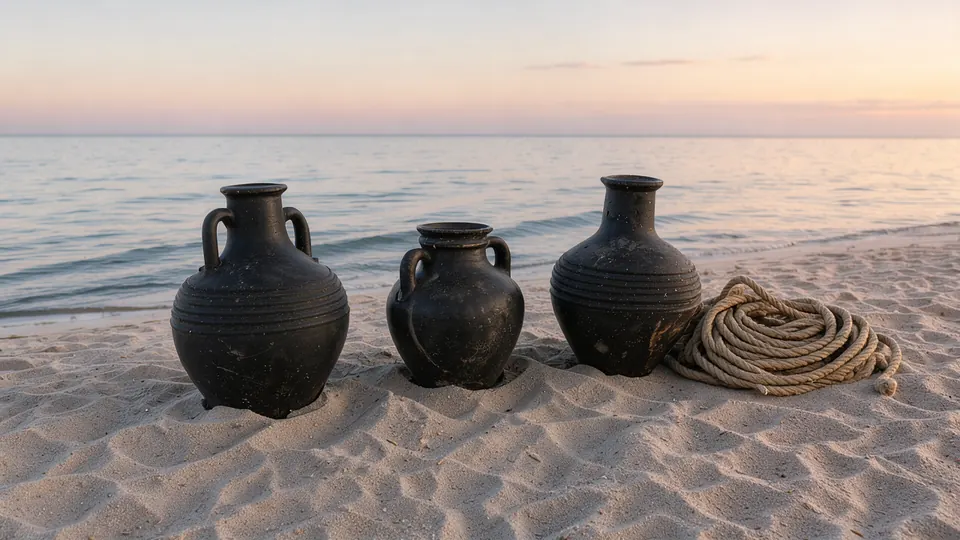
The fertile Thracian hinterland supplied the grain that fed the great cities of the Aegean, while local vineyards and fisheries produced wine and salted fish for export. In return, fine painted pottery from Athens and Corinth, olive oil from the southern Aegean, metalwork, and other luxury goods flowed into the harbour. Wine and oil moved in distinctive clay amphorae, many of which have been recovered from the seabed and from settlement layers during excavation.
A Greek Religious and Civic Centre
The Greeks built temples dedicated to Apollo, Hermes, and Zeus, establishing Mesembria as an important religious center. They also constructed a theater, an agora (marketplace), and public baths, bringing the sophisticated urban planning of Greek civilization to this remote corner of the Balkans.
Apollo held a special place in the colonial world, as the oracle at Delphi was traditionally consulted before founding a new colony; he was honoured as Apollo the Healer and the Founder. Inscriptions from the city record dedications and decrees that shed light on its religious calendar and civic institutions, and the worship of Dionysus, god of wine and the theatre, also flourished here, fitting for a city built on the wine trade. The agora served as the beating heart of public life, combining commerce, politics, and worship.
As a polis, Mesembria governed itself through an assembly of citizens and elected magistrates, struck its own coins, and conducted its own diplomacy, while honouring its Megarian and Dorian heritage in its calendar, dialect, and cults. Greek inscriptions found at Nessebar are written in the Doric dialect characteristic of its mother cities, a linguistic fingerprint linking it directly back to Megara. The city was wealthy enough to commission public buildings and monuments, and its citizens proudly identified themselves as Mesembrianoi, members of a free and ancient Greek community on the edge of the Thracian world.
What Visitors Can See Today
The Archaeological Museum of Nessebar, near the entrance to the Old Town, displays Mesembrian coins bearing the helmet and the city's name, Greek inscriptions, painted pottery, and architectural fragments from the classical and Hellenistic city. Sections of the ancient fortification walls at the isthmus rest on Greek-period foundations, and stretches of the harbour and necropolis have been studied by archaeologists. Although temples and the agora survive mainly as foundations and reused stone blocks, walking the compact peninsula gives a vivid sense of the city-state the colonists built more than 2,500 years ago.
To plan a visit and explore the layers of this remarkable peninsula, see our guide to Nessebar.
Frequently Asked Questions
When did Greeks colonize Mesembria?
Greek colonists from Megara, Byzantium, and Chalcedon settled in Mesembria in 510 BC, transforming the existing Thracian settlement into a Greek polis, or self-governing city-state.
Where did the Greek colonists of Mesembria come from?
They came from Megara and from its Bosphoran daughter-cities of Byzantium and Chalcedon. All were Dorian Greek foundations, so Mesembria belonged to a wider Megarian colonial network on the Black Sea.
What did Mesembria's ancient coins look like?
The city's coins typically showed a crested Corinthian helmet on one side, with the abbreviated city name (such as META or MESA) identifying the issuing polis. They circulated widely across the Black Sea and Mediterranean.
What did ancient Mesembria trade?
Mesembria exported grain from the Thracian hinterland, along with wine and fish, and imported olive oil, fine pottery, and luxury goods from across the Mediterranean, making it a key node in Pontic maritime trade.
Can I still see remains of the Greek city in Nessebar?
Yes. Coins, inscriptions, and pottery are displayed in the Archaeological Museum of Nessebar, and the fortification walls at the isthmus stand on foundations laid during the Greek period.
Get local stories & deals
One email a month with the best Black Sea stories and seasonal deals. No spam.