The Black Sea Seafood Guide: Local Fish, How It Is Cooked, When to Eat It
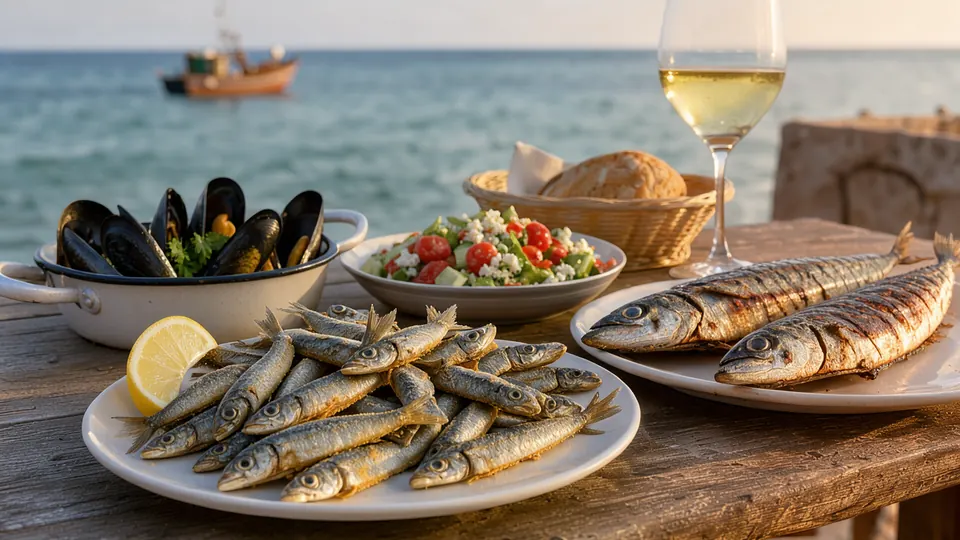
The Black Sea is a strange and wonderful body of water — brackish, less salty than the Mediterranean, fed by the Danube, and home to its own distinctive catch. The fish here are smaller and oilier than their ocean cousins, and Bulgarians have spent centuries learning exactly what to do with them: fry them whole, grill them over charcoal, steam the mussels in wine, and salt the autumn bonito for winter.
This is your guide to eating from the Black Sea around Nesebar — what the local catch actually is, how each is traditionally cooked, when it is in season, and where to buy and eat it. Skip the imported sea bream; this is the real coast.
The Local Catch, Fish by Fish
Tsatsa — sprat (цаца / TSA-tsa)
The undisputed king of Black Sea beach food. Sprat are tiny silver fish, two to three fingers long, dredged in seasoned flour and deep-fried whole in hot oil until crisp. You eat them entirely — head, bones, tail — with a squeeze of lemon and your fingers, washed down with cold beer. A plate (tsatsa) is the beach-bar and harbour-mehana staple, 4-6 €, and it is impossible to eat just one plateful. Peak season is summer.
Safrid — horse mackerel (сафрид / saf-RID)
The everyday grilled fish of the Bulgarian coast. Safrid is oily, full-flavoured, and ideal off the charcoal — scaled, gutted, salted, and grilled whole until the skin blisters, then served with lemon and a green salad. Cheap and excellent (6-9 € a plate). Also eaten fried. Available much of the year, best in late summer and autumn.
Palamud — Atlantic bonito (паламуд / pa-la-MUD)
The autumn prize. Bonito migrate through the Black Sea in September and October, fat and rich, and this is when the coast celebrates. Grilled fresh it is superb; traditionally Bulgarians also salt and air-dry it (solen palamud) to keep through winter. If you visit in autumn, this is the fish to order. 8-13 € fresh.
Lufar — bluefish (лefer / луфер / lu-FAR)
A prized, firm, meaty predator fish that runs in autumn alongside the bonito. Grilled or pan-fried, it is one of the finest the Black Sea offers and commands a higher price (9-15 €). A genuine local delicacy, not a tourist fish.
Kalkan — turbot (калкан / kal-KAN)
The aristocrat of the Black Sea. Turbot is a large flatfish with firm white flesh, traditionally cut into steaks and either grilled or pan-fried in flour. It is the special-occasion fish, the priciest on the menu (often 20-35 € per portion, sometimes sold by weight), and strictly seasonal — turbot fishing is regulated with a closed season in spring to protect spawning. If it is on the menu in early summer or autumn and confirmed fresh, it is a treat worth the splurge.
Barbun — red mullet (барбун / bar-BUN)
A small, sweet, prized fish, usually pan-fried in flour and eaten whole. Delicate and a little more expensive than safrid (9-13 €). A connoisseur's choice.
Karagyoz / skumriya — mackerel
Mackerel appears grilled and, famously, marinated or smoked. Smoked mackerel (pushena skumriya) sold from harbour stalls is a Black Sea classic.
Shellfish
Black Sea mussels (черноморски миди / cher-no-MOR-ski MI-di)
Small, sweet, and farmed sustainably along the Bulgarian coast, these are the coast's great affordable luxury. The classic preparations:
- Midi na buyon — steamed open in white wine, garlic, onion, and herbs, served in the broth with bread for dipping (the best version)
- Midi s ориз — cooked with rice into a kind of seafood pilaf
- Grilled — on the half-shell over charcoal
- Pane — breaded and fried
A generous bowl is 5-8 €. Order them by the harbour in Nesebar with cold white wine; this is the dish to come back for.
Rapana — rapa whelk (рапан / ra-PAN)
A large sea snail, ironically an invasive species that arrived from the Pacific and now thrives in the Black Sea — and Bulgarians turned the problem into a delicacy. The firm white meat is sliced and quickly pan-fried with garlic, butter, and parsley, or breaded. Chewy, sweet, satisfying. 7-11 €. A true Black Sea specialty you will not find inland.
Skariди — Black Sea shrimp
Small local shrimp appear seasonally, fried or in garlic sauce. Less common than mussels and rapana but worth ordering when fresh.
How the Season Works
| Season | What is best | Notes |
|---|---|---|
| Spring (Mar-May) | Mussels, early safrid | Turbot closed season protects spawning |
| Summer (Jun-Aug) | Tsatsa, mussels, safrid, rapana | Peak for fried sprat and steamed mussels |
| Autumn (Sep-Oct) | Palamud (bonito), lufar (bluefish), barbun | The connoisseur's season — migratory fish are fat and rich |
| Winter (Nov-Feb) | Salted palamud, smoked mackerel | Fresh catch limited; preserved fish shines |
The golden rule: autumn is the seafood season on the Black Sea. If you can visit in September or October, the migratory bonito and bluefish are the finest eating of the year — and the prices and crowds have dropped.
Where to Buy and Eat It
- Harbour mehanas in Nesebar Old Town — for steamed mussels, fried tsatsa, and grilled safrid with a sea view.
- Fish markets and harbour stalls — Nesebar's working harbour and the larger fish market in nearby Burgas sell the fresh catch; smoked mackerel and salted palamud are stall classics.
- Sozopol and Chernomorets — fishing towns south of Burgas with strong seafood traditions, an easy day trip.
- Sveti Vlas marina — modern restaurants with good fish, just north of Nesebar.
To buy and cook yourself, look for the morning catch at the harbour and ask "dnes uloveno li e?" (was it caught today?).
How to Order Like You Know
- Ask "mestna riba li e?" (is it local fish?) — the honest answer tells you a lot about the restaurant.
- For the authentic experience, choose tsatsa, safrid, mussels, rapana, and (in autumn) palamud over imported sea bream and bream.
- Pair white wine — a dry Dimyat or Traminer from the nearby Black Sea wineries — with fish; it is grown to go with this catch.
- Grilled and fried whole fish is served with the head on; this is normal and the cheeks are the best bit.
A seafood feast for two by the harbour — mussels, fried tsatsa, a grilled fish to share, salad, bread, and a carafe of Dimyat — runs about 30-45 € (€30-46). In autumn, swap in a grilled bonito and it becomes one of the best meals on the coast.
Stay beside the working harbour and eat the catch nightly — browse apartments and houses in Nesebar, and find more food guides in our articles.
FAQ
Is Black Sea fish safe and good quality?
Yes. The local catch — sprat, horse mackerel, bonito, mussels, rapana — is fresh and a long-standing part of the coastal diet. Black Sea mussels are farmed under EU food standards.
Why is turbot (kalkan) so expensive?
Turbot is a large, slow-growing flatfish whose fishery is tightly regulated with a spring closed season to protect spawning stock. Limited supply and high demand make it the priciest fish on the coast — and a genuine treat.
What is rapana and is it worth trying?
Rapana is a large sea snail, an invasive species the Black Sea coast turned into a delicacy. Pan-fried with garlic and butter it is chewy, sweet, and uniquely Black Sea — definitely worth trying.
When is the best time of year for seafood here?
Autumn (September-October), when migratory bonito (palamud) and bluefish (lufar) pass through fat and rich. Summer is best for fried tsatsa and steamed mussels.
What wine goes with Black Sea fish?
A dry local white — Dimyat, Traminer, or a Black Sea Chardonnay from the nearby coastal wineries. These grapes are grown specifically to complement the regional catch.
Can I buy fresh fish to cook in my apartment?
Yes — Nesebar's harbour and the Burgas fish market sell the daily catch. Ask if it was caught today, and keep it cold on the way back.
Get local stories & deals
One email a month with the best Black Sea stories and seasonal deals. No spam.