Ancient Coins of Mesembria: A Numismatic Legacy
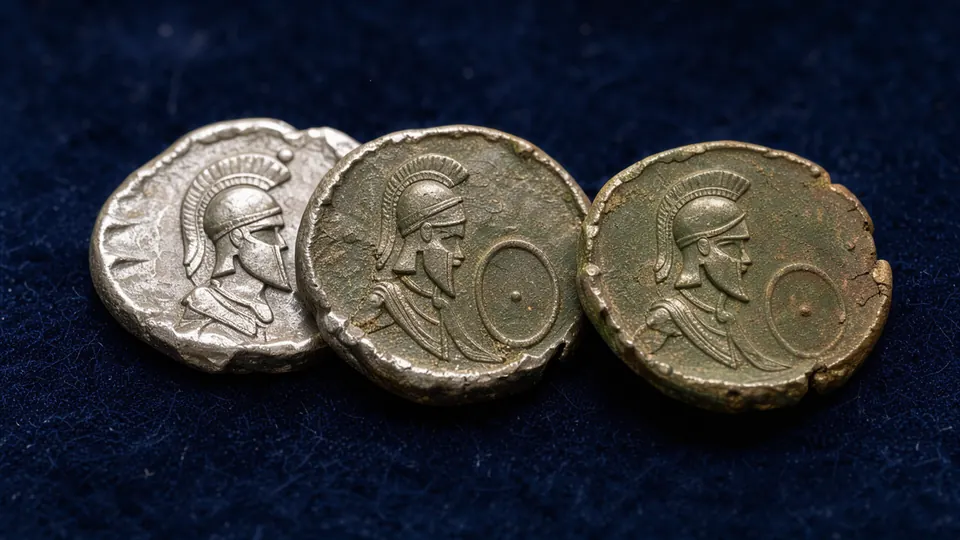
Mesembria was one of the most prolific coin-minting cities on the western Black Sea coast, producing coinage almost continuously from the 5th century BC to the 1st century AD. Few classes of artefact tell us as much about an ancient city as its coins, and Mesembria's are no exception: minted in silver and bronze across some five centuries, they provide invaluable evidence about the city's economic importance, its cultural connections, its religious life, and its political history. To read a coin of Mesembria is to hold a small, deliberate statement of civic identity in the palm of your hand.
The Earliest Silver
The earliest coins of Mesembria, dating from around 450 BC, are small silver pieces — fractional denominations suited to everyday transactions in a busy port. Their design is austere and powerful: the obverse typically bears a wheel or a Corinthian-style radiate helmet, while the reverse carries a simple incuse pattern, the characteristic sunken square impressed by the punch used in early Greek striking. The helmet, a symbol of the protection of the goddess Athena, was no idle decoration. It declared the city's Greek colonial origins and proclaimed its connections to Megara and the other Dorian Greek cities from whose world Mesembria sprang. From the very first issues, the coinage was a tool of identity as much as of commerce.
The Hellenistic Flowering
During the Hellenistic period (3rd-1st centuries BC), the wider Greek world entered an age of expanded trade, larger states, and more ambitious art, and Mesembria's coinage developed accordingly. The city now produced larger silver and bronze coins with more elaborate and varied designs, reflecting both its growing prosperity and the rich visual vocabulary of the Hellenistic age.
Motifs and Meanings
The most characteristic motifs of these issues include a crested helmet of the Corinthian type, recalling the earliest coins and binding the centuries of minting into a single tradition; the city's name, rendered as the abbreviation META or MESA, asserting civic pride; and images of the deities who watched over the community — Athena, the warrior-protectress; Hermes, patron of merchants and travellers, fittingly honoured in a trading city; and Demeter, goddess of grain and the fertility on which prosperity ultimately rested. Some coins also feature the image of a dolphin, an elegant emblem of the city's maritime character and its dependence on the sea. Each device was a choice, and together they paint a portrait of how Mesembria wished to present itself to the wider world.
The bronze coinage of this period deserves particular mention, for it was the everyday money of the marketplace. Where silver served larger transactions and inter-city trade, the more numerous bronze pieces passed from hand to hand in the daily commerce of a busy port — bought a measure of fish, paid a porter, settled a small debt. Their survival in such quantity is one reason archaeologists find Mesembrian coins so frequently, and why they are so useful in tracing the rhythms of ordinary economic life. Some issues bear the names or monograms of individual magistrates responsible for the minting, a detail that occasionally allows historians to connect a coin to a particular moment and even to the individuals who governed the city.
A Window onto the Ancient Economy
Because coins were struck in known places and circulated along trade routes, they allow historians to reconstruct economic relationships that no written source records. The wide distribution of Mesembrian coins, found at sites around the Black Sea and beyond, testifies to the reach of the city's commerce. The metals used, the weights adopted, and the standards followed reveal which economic systems the city participated in and which of its neighbours it traded with most closely. The very continuity of the coinage — five centuries of more or less uninterrupted minting — is itself evidence of remarkable stability and enduring commercial vitality.
Coins as Historical Documents
Beyond their economic value, the coins also serve as miniature political and chronological records. Changes in style, weight, and inscription often mark shifts in the city's fortunes: the appearance of new standards can signal a change of trading partners or overlords, while the persistence of old types expresses continuity and civic pride. Because each coin can frequently be dated by its design, numismatists use these tiny objects to anchor the wider archaeology of the site, helping to fix the chronology of buildings and layers that would otherwise be hard to date. In this way the coinage of Mesembria functions almost as a written archive, preserving information in metal that the perishable records of the ancient city have long since lost.
The artistry, too, repays close attention. The finest of the silver issues display the confident, idealised modelling typical of the best Greek die-engraving, and the helmets in particular are rendered with a crispness that speaks to the skill of the craftsmen the city was able to employ. The choice of Athena, Hermes, Demeter, and the dolphin was not random but a deliberate self-portrait: a city of warriors and traders, blessed by the gods of wisdom, commerce, and the fertile earth, and bound inseparably to the sea.
What Visitors Can See Today
These ancient coins are now prized by collectors and scholars worldwide. The Archaeological Museum of Nessebar houses an impressive collection of locally minted coins, displayed alongside other finds that set them in their archaeological context, so that visitors can examine the helmets, dolphins, and deities at first hand and appreciate the craftsmanship of the ancient die-engravers. Beyond Nessebar, specimens of Mesembrian coinage can be found in major numismatic collections across Europe, a measure of how highly these small objects are valued. For the visitor, the museum's cases offer the chance to look directly into the economic and spiritual life of the ancient city, for each coin tells a story about the commerce, the religious beliefs, and the artistic tastes of ancient Mesembria.
Frequently Asked Questions
How long did Mesembria mint its own coins?
Almost continuously from the 5th century BC to the 1st century AD — roughly five hundred years.
What do the earliest coins look like?
Small silver pieces dating from around 450 BC, with a wheel or a radiate Corinthian helmet on the obverse and an incuse (sunken) pattern on the reverse.
What images appear on the Hellenistic coins?
A crested Corinthian helmet, the city's name as META or MESA, and deities such as Athena, Hermes, and Demeter; some coins also depict a dolphin symbolising the city's maritime character.
Why is the helmet so common on Mesembrian coins?
It is a symbol of the protection of Athena and a marker of the city's Greek colonial origins and its connections to Megara and other Greek cities.
Where can I see Mesembrian coins today?
The Archaeological Museum of Nessebar holds an impressive collection, and other specimens are kept in major numismatic collections across Europe.
Explore the ancient roots of this Black Sea city and plan your own visit through our guide to Nessebar.
Get local stories & deals
One email a month with the best Black Sea stories and seasonal deals. No spam.