A Coast That Is Moving: Erosion, Storms and What Is Changing on the Black Sea
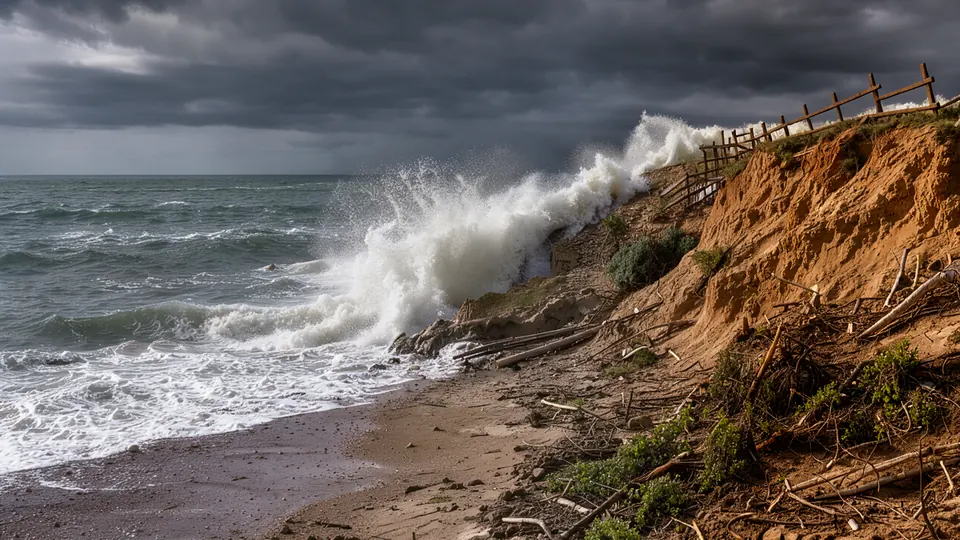
A Coast That Is Moving
The beach you are lying on is not a permanent feature. Coastlines move on their own, and this one is moving faster than it used to, for reasons that are partly natural and partly the buildings behind it.
This is not an alarm. It is the sort of context that makes a familiar place more interesting, and it explains several things a visitor notices without being able to name.
Why the sand comes and goes
A beach is a river of sand, not a fixed thing. Sediment arrives from rivers and cliffs, moves along the coast on the prevailing current, and leaves. A stable beach is one where arrivals and departures happen to balance.
Three things upset that balance on this coast.
Rivers deliver less. Dams and river regulation upstream trap sediment that would once have reached the sea. The Danube, which feeds the whole north-western Black Sea, carries a fraction of what it did.
Structures interrupt the flow. Every harbour wall, breakwater and groyne along a coast catches sand on one side and starves the beach on the other. The result is visible here if you look: sand piled against one side of a structure and a scoured, narrow beach immediately downstream of it.
Building on the dunes removes the reserve. Dunes are the savings account a beach draws on in a storm — the sand goes out, then comes back. Build on them and the sand that goes out does not return.
The dunes
Bulgaria's coastal dune formations are protected, and around this coast they are also a live political subject. Construction pressure on the strip has been intense for two decades, and dune systems have been damaged or built over in places despite the protections.
You will see remnants of them on the wilder beaches north and south of the resort strip. They look like scrubby sand hummocks with coarse grass, which is exactly why people think they are waste ground. They are the thing that keeps the beach there.
Walk around them rather than over them: the grass roots are what holds the sand, and a footpath through a dune becomes a blowout within a couple of seasons.
Storms
The Black Sea is not a benign pond. Winter storms here are serious, and the coast takes real damage in them — sand stripped off beaches, promenades undermined, seafront structures broken.
A visitor in July sees none of this. What you do see, if you look, is the repair: fresh concrete on a sea wall, replaced paving, a beach that has been mechanically replenished before the season.
Beach nourishment — trucking or pumping sand back onto a beach — is the standard response along developed coasts everywhere, and it is a treatment rather than a cure. It has to be repeated.
The sea itself
Two changes are documented in the Black Sea and both are visible in the ecosystem rather than from a sunbed.
Warming. Surface temperatures have risen, which shifts which species live where, extends the jellyfish season, and affects the fish that the local fleet depends on.
The anoxic layer. Below roughly 150 metres the Black Sea has no oxygen and no life — a natural feature of a nearly enclosed sea with a strong salinity gradient. The concern is the depth of the boundary and whether nutrient runoff pushes it upward, compressing the living layer.
Add a century of overfishing and the arrival, in ballast water in the 1980s, of a comb jelly that collapsed the anchovy fishery, and the Black Sea has been through a great deal. Conditions have improved since the worst of the 1990s.
What a visitor can actually do
Small things, but they are the honest list.
Stay off the dunes. The single most useful one.
Take your rubbish from the wild beaches. Nobody cleans them; they stay pleasant only because visitors carry out what they bring.
Do not take sand or shells in quantity. A pocketful is nothing; the coast has had commercial sand removal problems, which is a different scale.
Choose operators who behave. Boat trips that chase dolphins, and beach businesses that bulldoze dunes for a better view, respond to money the way everything does.
The short version
The beach moves, the dunes are what keep it there, and the structures that make a resort convenient are part of why the sand is where it is. None of this spoils a holiday — but the scrubby grass behind the beach is not waste ground, and walking around it costs nothing.
Get local stories & deals
One email a month with the best Black Sea stories and seasonal deals. No spam.